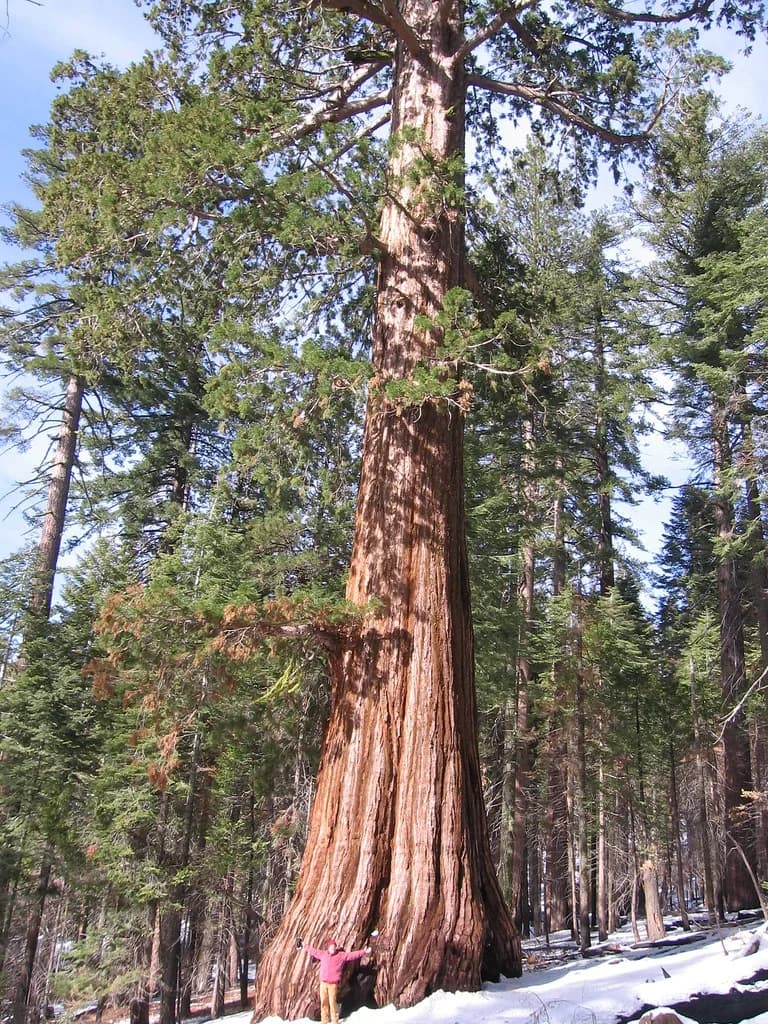
Mature form · Photo: A. Poulos · CC BY 2.0 · Source · Converted to WebP
01 · Meet the tree
Meet giant sequoia.
A giant sequoia can invite wonder through its scale, yet the encounter can begin with a single twig or a pattern in the bark. A planted garden specimen need not resemble a massive California forest elder to reward your attention.
Foliage
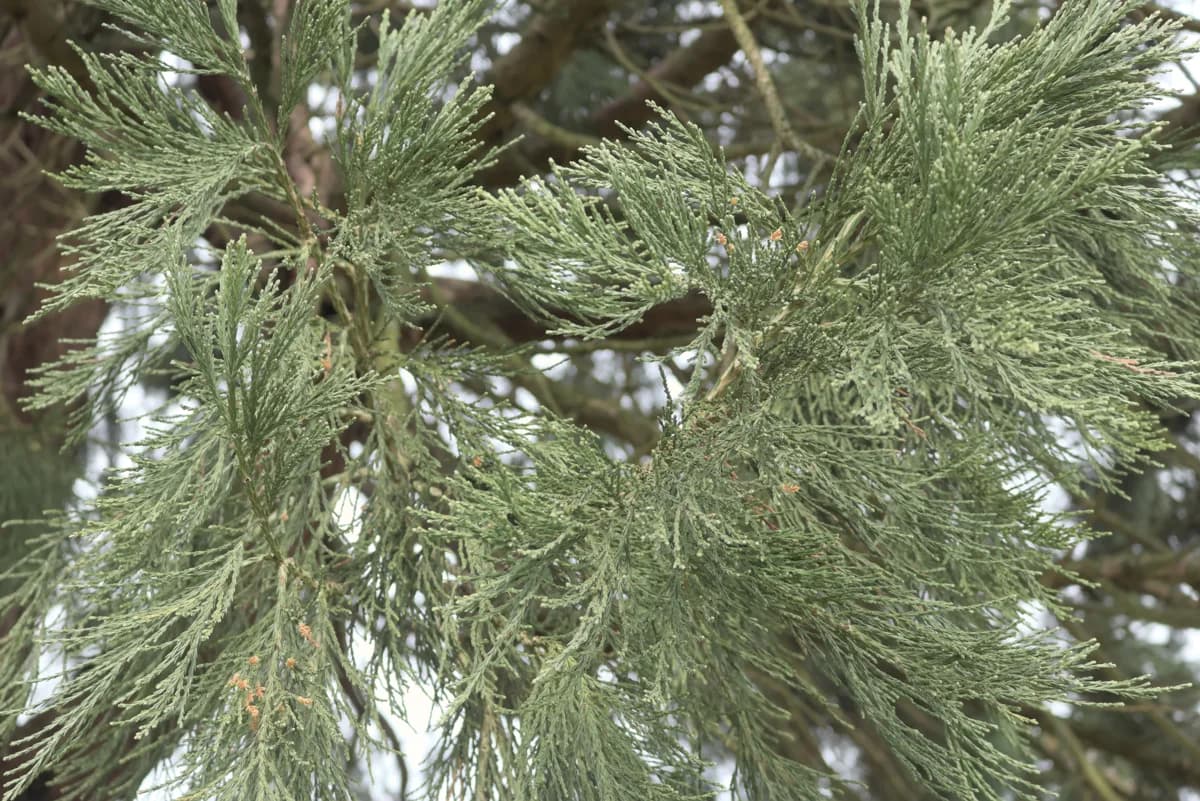
Evergreen foliage consists of small, pointed, scale-like to awl-shaped leaves arranged around twigs. This differs from the flat sprays of many coast redwood shoots and from dawn redwood, which sheds its foliage seasonally. Compare several features.
Bark and cones
Reddish-brown bark becomes thick, fibrous, and deeply furrowed. Woody oval seed cones are commonly around two inches long. Observe bark from a suitable distance; do not remove fibers or collect attached cones.
Place and scale
The native groves lie on the western slopes of California’s Sierra Nevada. Giant sequoias are also cultivated elsewhere, including at Blithewold in Rhode Island. A planted specimen’s size does not establish its age, and a champion designation is a size record rather than an age certificate.
Look closer.
Compare several features, and notice how age and season change their appearance. These photographs are starting points for observation; leave living leaves, needles, cones, and bark attached.
Look for fresh tip growth against older foliage and cones when they are within view. Winter keeps an evergreen outline visible, while light and surrounding vegetation change. Compare one detail across seasons without assuming a garden tree has the age or dimensions of a native grove elder.
Choose a place to encounter giant sequoia. Each guide brings together arrival, walking, access information, and a practice. Check its dated visitor sources before travelling.
Three qualities to contemplate beside the tree. Begin with what you can observe, then see what meaning emerges for you.
These tree-specific associations are new contemplative interpretations for the digital school. “Energy” here describes felt experience and symbolism; it is not a measured healing field or a promise of a particular effect.
Perspective
A large trunk and a small twig belong to one tree.
Changing the scale of attention can help you see a concern differently.
What changes when I widen my view?
Wonder
Fibrous bark and pointed foliage offer intricate patterns.
Wonder can begin in a detail without requiring a spectacular feeling.
What is unfamiliar when I look again?
Patience
The crown and trunk develop over many growing seasons.
Allow worthwhile work to have a timescale beyond today.
What deserves patient care?
03 · Practice with this tree · About 5 minutes
A wider scale. One small detail.
A new observation meditation moving between scale and detail beside giant sequoia. The practice can be completed from a bench or established garden path.
Choose stable ground in a permitted place, with your usual supports. You do not need to see the top or tilt your head back; a visible section of trunk is enough.
Take in a larger form
Notice the outline of the trunk or a group of branches. Let the eye travel only as far as is comfortable, without estimating an age from size.
Rest with a small pattern
Choose a bark line, a patch of foliage, or an opening against the sky. Give that detail a few natural breaths of attention.
Return to your own scale
Move once more between detail and wider view. Name one patient next step in something you care about, then let the visit end.
Let the visit be enough.
Spend about five minutes, or less if that suits you. Keep your device available when needed. No touching, collecting, controlled breathing, or tree-supported movement is required; leave the tree and its surroundings undisturbed.
The book teaches attention and learning from trees. This page adds a species-specific encounter; it does not claim that the original book assigned these three energies to giant sequoia.
Choose a tree with care.
Chapter 3 introduces three pathways and choosing an appropriate setting.
What changed when you gave the large form and the small detail equal attention?
Reflect quietly or write a sentence in your own notebook. On another visit, look at the same detail again. Your experience may fit these themes, suggest something different, or simply be a few minutes of looking.