Leaves
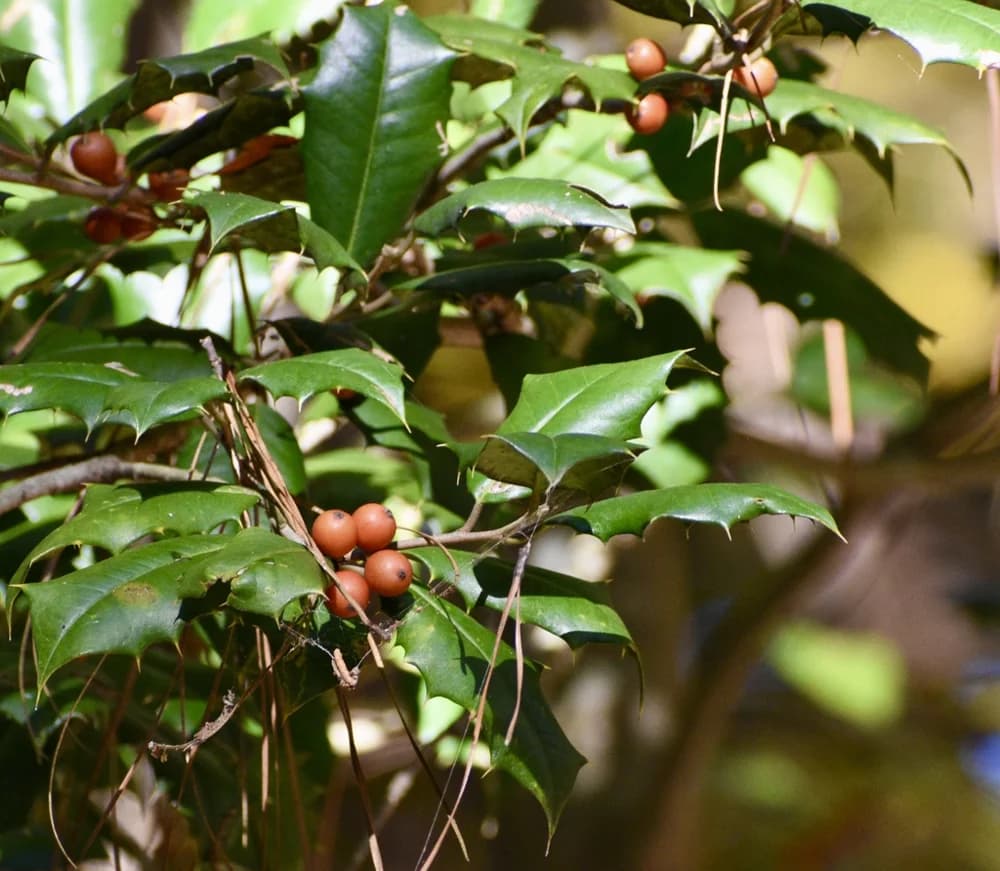
Evergreen leaves are leathery, alternate, and typically dull dark green with sharp marginal spines. Look without grasping or rubbing them.
American Holly · Ilex opaca
Make room for shelter and a boundary that supports it.
01 · Meet the tree
American holly keeps green leaves through winter and can shelter wildlife within its branches. Its leaf margins invite a reflection on boundaries alongside care. Observe from a comfortable distance, letting protection mean making space for life rather than closing yourself to it.
Evergreen leaves are leathery, alternate, and typically dull dark green with sharp marginal spines. Look without grasping or rubbing them.
Small pale flowers appear in spring. Female trees can carry red fruits when pollinated by a nearby male tree. Leave fruits for wildlife; they are not for tasting.
Native to the eastern United States, American holly grows in woodland and planted settings. A dense crown may contain wildlife; observe without entering the branches or approaching nests.
Compare several features, and notice how age and season change their appearance. These photographs are starting points for observation; leave living leaves, needles, cones, and bark attached.
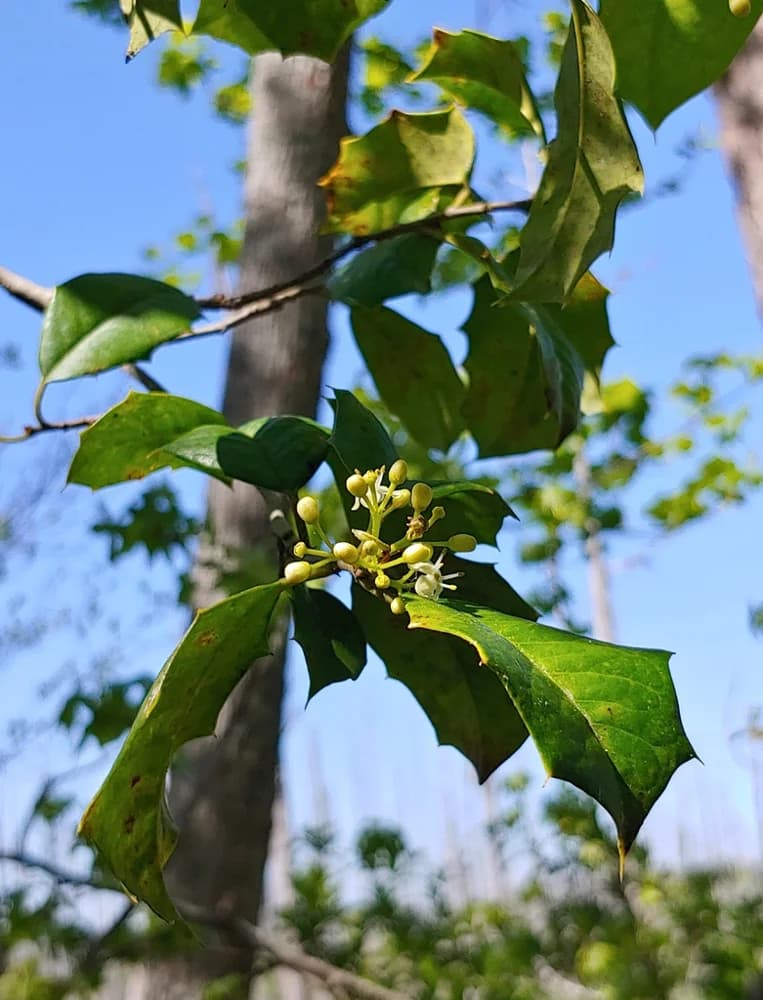
Green foliage remains visible through winter while individual leaves eventually age and fall. Spring brings flowers and new growth. Fruits on pollinated female trees color in autumn and can persist into winter; their absence does not rule out this species.
Botanical reference: NC State Extension’s american holly profile. This is a starting point for observation, not a complete identification key.
02 · Energy & character
Three qualities to contemplate beside the tree. Begin with what you can observe, then see what meaning emerges for you.
These tree-specific associations are new contemplative interpretations for the digital school. “Energy” here describes felt experience and symbolism; it is not a measured healing field or a promise of a particular effect.
Layers of foliage make protected spaces among branches.
Notice what makes a place supportive and how to preserve it.
What helps you feel sheltered?
Sharp leaf margins give the foliage a distinct edge.
Consider a clear, kind limit that protects your capacity to care.
What boundary would support your well-being?
The crown can hold lives that remain out of sight.
Give others room without needing access to every part of their world.
Where could respectful distance be an act of care?
03 · Practice with this tree · About 5 minutes
An original five-minute observation practice. Read once, then give your attention to the tree; sitting, standing, or observing from a distance are equally welcome.
Open outdoor practice →Choose stable, permitted ground at a comfortable distance from spiny foliage. Sit or stand with your normal supports.
Look at one gap between branches and the foliage around it. Keep your breathing natural and leave wildlife undisturbed.
Consider one request or commitment in your day. Identify a limit that would help you meet it with care.
Choose one way to create a more supportive space for yourself or someone else. Widen your view before finishing.
Spend about five minutes, or less if that suits you. Keep your device available when needed. No touching, collecting, controlled breathing, or tree-supported movement is required; leave the tree and its surroundings undisturbed.
04 · Roots in the book
The book teaches attention and learning from trees. This page adds a species-specific encounter; it does not claim that the original book assigned these three energies to american holly.
Chapter 3 introduces three pathways and choosing an appropriate setting.
Read the chapter companionOriginal: printed pp. 13–17Chapter 4 encourages a sustainable beginning with five or ten minutes.
Read the chapter companionOriginal: printed p. 28Shelter, Boundaries, Care connect this new practice with Chapter 6’s invitations to learn from trees.
Explore Wisdom and WonderOriginal: Chapter 6, printed pp. 96–12405 · Notice for yourself
Reflect quietly or write a sentence in your own notebook. On another visit, look at the same detail again. Your experience may fit these themes, suggest something different, or simply be a few minutes of looking.