Leaves and branches
Simple, alternate leaves have smooth to slightly wavy margins and pointed tips. Many trees carry stout thorns on their twigs; some cultivated forms are thornless. Observe without reaching into branches.
Osage Orange · Maclura pomifera
Find a comfortable distance. Let a clear boundary make room for care.
01 · Meet the tree
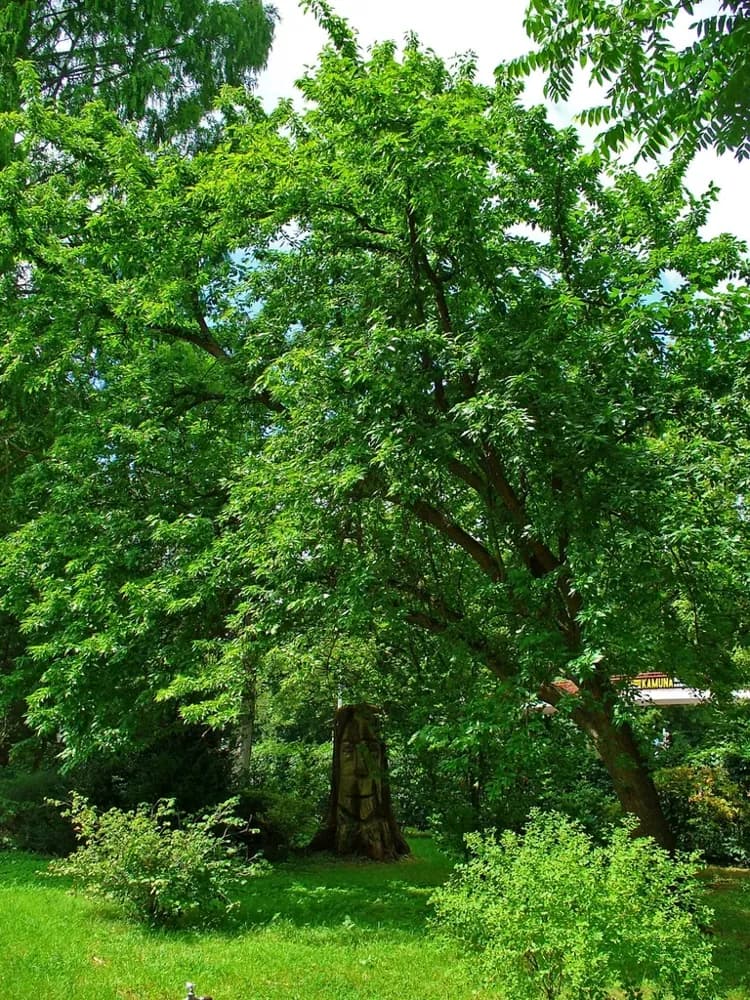
An Osage orange invites you to notice edges: the outline of a crown, the meeting of leaf and sky, the space between your body and a branch. Its history as a living fence offers a starting point for reflection on boundaries. Begin with the individual tree, rather than asking its toughness to explain your life.
Simple, alternate leaves have smooth to slightly wavy margins and pointed tips. Many trees carry stout thorns on their twigs; some cultivated forms are thornless. Observe without reaching into branches.
Female trees can bear large, wrinkled, yellow-green fruits. Mature bark is orange-brown and deeply ridged. This is a mulberry-family tree, not a citrus orange; leave fruit and sap undisturbed.
Native to parts of Texas, Oklahoma, and Arkansas, Osage orange has been planted and naturalized widely. Dense, thorny growth was historically used for hedgerows. Look for several features before naming a tree.
Compare several features, and notice how age and season change their appearance. These photographs are starting points for observation; leave living leaves, needles, cones, and bark attached.
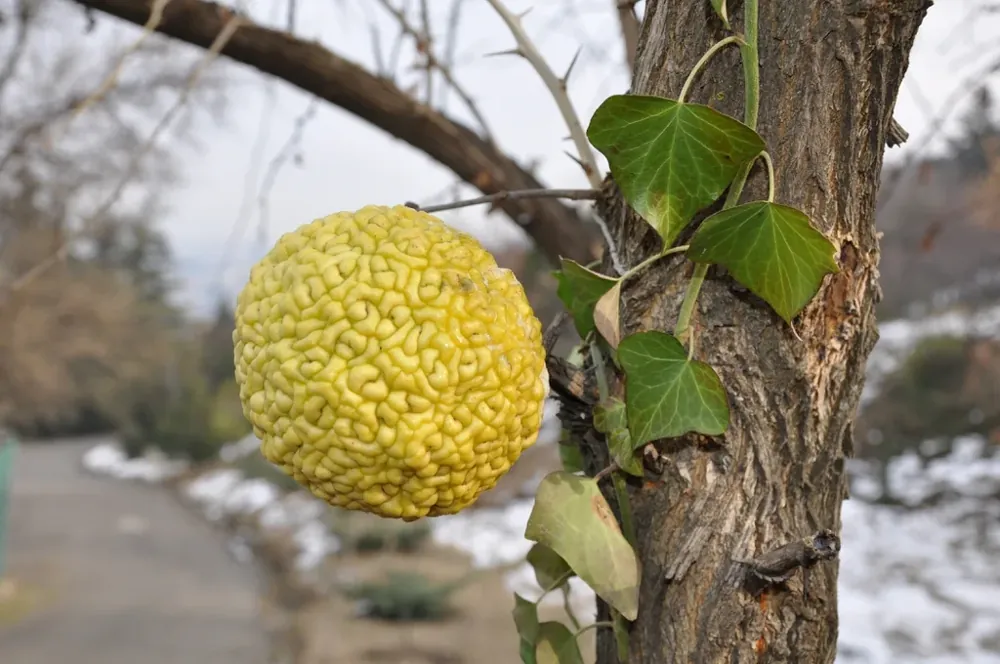
Spring brings new leaves and small flowers. Fruits on female trees mature in autumn, when foliage can turn yellow. In winter, notice the irregular branch outline and ridged bark. Fallen fruits can make footing uneven; choose a clear viewing place.
Botanical reference: NC State Extension’s osage orange profile. This is a starting point for observation, not a complete identification key.
02 · Energy & character
Three qualities to contemplate beside the tree. Begin with what you can observe, then see what meaning emerges for you.
These tree-specific associations are new contemplative interpretations for the digital school. “Energy” here describes felt experience and symbolism; it is not a measured healing field or a promise of a particular effect.
The crown has a visible outline, and many twigs carry thorns.
Consider a boundary that protects your attention while allowing connection. You can care without reaching into every situation.
What deserves a little protected space?
The tree's shape includes bends, crowded growth, and openings.
Let its particular form prompt a flexible response to difficulty. Resilience can include changing your position and asking for support.
Where could flexibility help you continue?
Fruit, leaves, and branches occupy a place shared with wildlife.
Practice care by leaving room for the lives already here. Attention need not become possession.
What can you appreciate without taking?
03 · Practice with this tree · About 5 minutes
An original five-minute practice of distance, attention, and boundaries. Sit or stand with your usual supports; no touching or special breathing is needed.
Open outdoor practice →Choose stable, permitted ground away from thorns, loose fruit, and damaged branches. Notice the space between you and the tree. Adjust until looking feels comfortable.
Follow a short section of the crown with your eyes, then pause at one leaf or branch. Let your breath remain natural. Notice where the tree's outline meets the sky.
Quietly consider one limit you would like to express: a time to rest, a task you can decline, or space to finish something. Choose simple words without rehearsing an argument.
Widen your view to the surrounding place. Imagine stating your boundary calmly, with care for yourself and others. Choose one small next action and finish at your own pace.
Spend about five minutes, or less if that suits you. Keep your device available when needed. No touching, collecting, controlled breathing, or tree-supported movement is required; leave the tree and its surroundings undisturbed.
04 · Roots in the book
The book teaches attention and learning from trees. This page adds a species-specific encounter; it does not claim that the original book assigned these three energies to osage orange.
Chapter 3 introduces three pathways and choosing an appropriate setting.
Read the chapter companionOriginal: printed pp. 13–17Chapter 4 encourages a sustainable beginning with five or ten minutes.
Read the chapter companionOriginal: printed p. 28Presence, balance, and connection connect this new practice with Chapter 6’s invitations to learn from trees.
Explore Wisdom and WonderOriginal: Chapter 6, printed pp. 96–12405 · Notice for yourself
Reflect quietly or write a sentence in your own notebook. On another visit, look at the same detail again. Your experience may fit these themes, suggest something different, or simply be a few minutes of looking.