Leaves
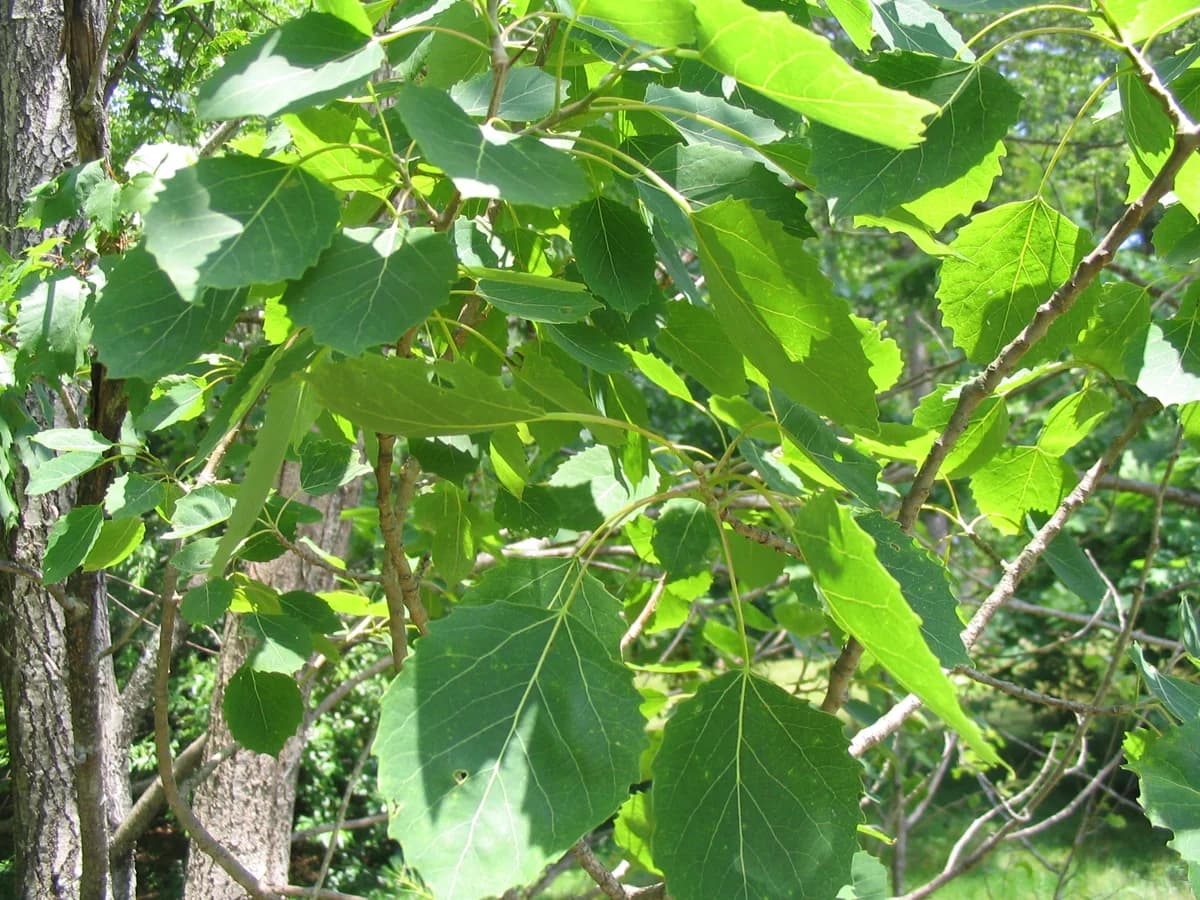
Simple, alternate leaves have conspicuous coarse teeth around the edge. These teeth are not deep lobes. Compare mature leaves: quaking aspen generally has much finer teeth, and one damaged leaf can be misleading.
 Tree Yoga SchoolPractice with the living world
Bigtooth aspen · Populus grandidentata
Follow a leaf’s edge, then notice the wider woodland it belongs to.
01 · Meet the tree
Bigtooth aspen announces itself in the large teeth along its leaves. In sunny woodland openings it can be part of a changing forest, making room for attention to individual details and the lives growing nearby.
Simple, alternate leaves have conspicuous coarse teeth around the edge. These teeth are not deep lobes. Compare mature leaves: quaking aspen generally has much finer teeth, and one damaged leaf can be misleading.
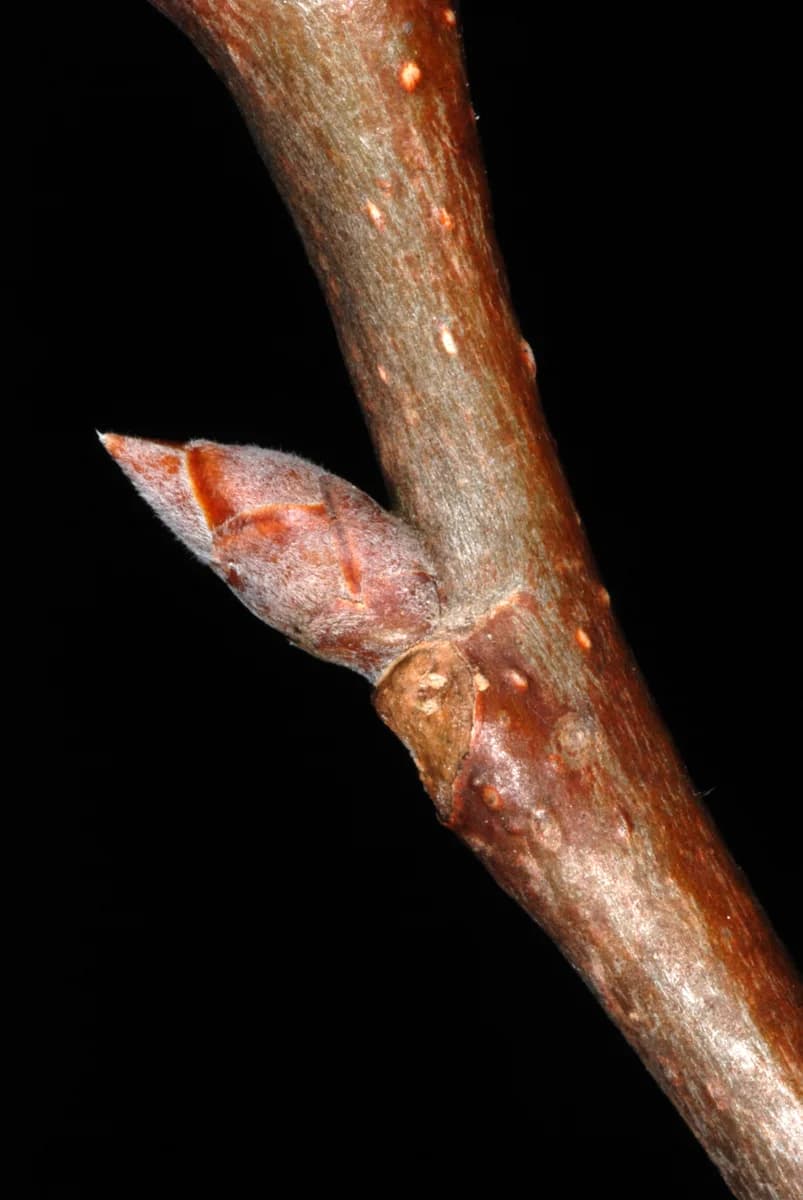
Bark can be relatively smooth on younger trunks and ridged or plated on older portions. Winter buds have overlapping scales and can be hairy. Age changes the bark, so it should not be the only clue.
Native across New England and other parts of northeastern North America, bigtooth aspen occurs in woods, edges, and openings, often on sandy uplands. It can spread through root suckers; nearby stems are not necessarily separate seed-grown individuals.
Compare several features, and notice how age and season change their appearance. These photographs are starting points for observation; leave living leaves, needles, cones, and bark attached.
In leaf season, compare large marginal teeth on several mature leaves and watch for movement in a breeze. Later, notice leaf fall and the changing openness of the crown. Winter offers buds and bark to observe. A return visit can reveal woodland change that a single photograph cannot show.
Chapter 4 invites a practice of returning across seasons. Read When and Where Try the seasonal observation practice
Botanical reference: Native Plant Trust Go Botany bigtooth aspen profile. This is a starting point for observation, not a complete identification key.
02 · Energy & character
Three qualities to contemplate beside the tree. Begin with what you can observe, then see what meaning emerges for you.
These tree-specific associations are new contemplative interpretations for the digital school. “Energy” here describes felt experience and symbolism; it is not a measured healing field or a promise of a particular effect.
Aspen can spread into sunny openings through new shoots.
A beginning can emerge within a larger, continuing life.
What small beginning is available to me?
Some neighboring stems may arise from connected roots.
Use the possibility of unseen connection as a reflection, without assuming you know this tree’s roots.
What support may be easy to overlook?
Large teeth make a familiar leaf outline distinctive.
Let one difference lead to a question rather than a quick conclusion.
What changes when I look more closely?
03 · Practice with this tree · About 5 minutes
A new observation practice moving from a small leaf detail to the surrounding woodland, exploring curiosity and connection without disturbing the tree.
Open outdoor practiceChoose stable ground on a permitted route. Sit or stand with your usual supports and find a visible leaf or naturally fallen example.
Look at the large teeth along the leaf margin. If leaves are absent, follow a twig or bark pattern instead. Leave living growth attached.
Include the twig, trunk, neighboring stems, and openings in the canopy. Notice relationships you can see while leaving unseen roots as an open question.
Name a detail to revisit or a question to explore. Consider one small connection you would like to care for in your own day.
Spend about five minutes, or less if that suits you. Keep your device available when needed. No touching, collecting, controlled breathing, or tree-supported movement is required; leave the tree and its surroundings undisturbed.
04 · Roots in the book
The book teaches attention and learning from trees. This page adds a species-specific encounter; it does not claim that the original book assigned these three energies to bigtooth aspen.
Chapter 3 introduces three pathways and choosing an appropriate setting.
Read the chapter companionOriginal: printed pp. 13–17Chapter 4 encourages a sustainable beginning with five or ten minutes.
Read the chapter companionOriginal: printed p. 28Presence, adaptability, and unconditional love connect this new practice with Chapter 6’s invitations to learn from trees.
Explore Wisdom and WonderOriginal: Chapter 6, printed pp. 96–12405 · Notice for yourself
Reflect quietly or write a sentence in your own notebook. On another visit, look at the same detail again. Your experience may fit these themes, suggest something different, or simply be a few minutes of looking.