Leaves
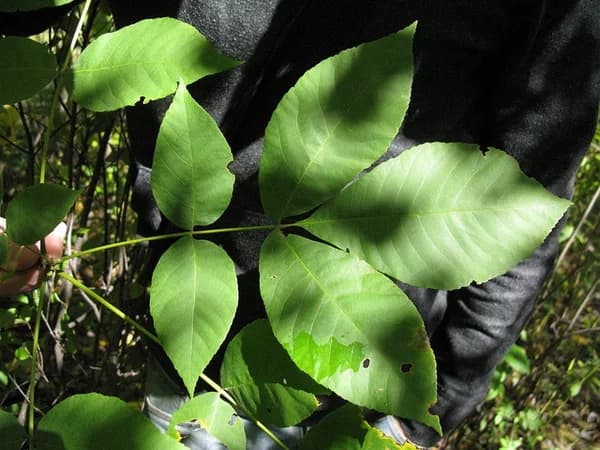
Alternate, pinnately compound leaves usually carry five to seven toothed leaflets along a central stalk. The terminal leaflet is larger. Buckeye leaves, by contrast, are opposite and fan-shaped.
Pignut Hickory · Carya glabra
Follow a line of leaflets and find a steadier rhythm of attention.
01 · Meet the tree
Pignut hickory draws attention through a compound leaf: several distinct leaflets sharing one stalk. Its textured bark and seasonal nuts offer a quiet invitation to steady observation and connection.
Alternate, pinnately compound leaves usually carry five to seven toothed leaflets along a central stalk. The terminal leaflet is larger. Buckeye leaves, by contrast, are opposite and fan-shaped.
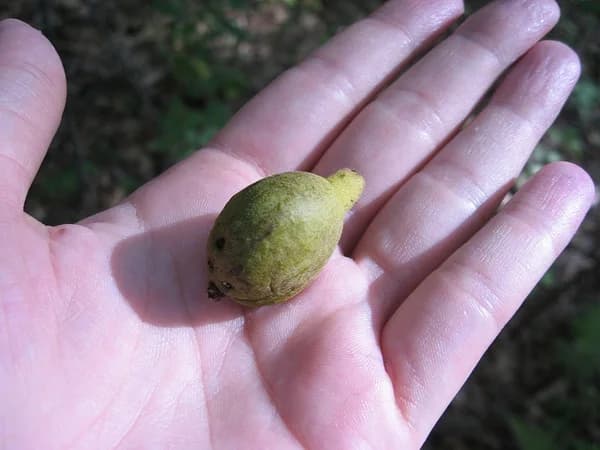
Oval nuts are enclosed in husks with four divisions that mature from green to brown. Older bark develops sharp-edged ridges with diamond or X-shaped patterns; it does not have shagbark hickory’s long peeling strips.
A native of eastern North America, pignut hickory grows in well-drained woodland soils. Nuts feed many mammals, and its foliage supports butterfly and moth larvae.
Compare several features, and notice how age and season change their appearance. These photographs are starting points for observation; leave living leaves, needles, cones, and bark attached.
Spring brings unfolding compound leaves and drooping male catkins. Green summer foliage turns yellow in autumn as nuts mature. Winter makes the buds, ridged bark, and branching pattern easier to observe.
Chapter 4 invites a practice of returning across seasons. Read When and Where → Try the seasonal observation practice →
Botanical reference: NC State Extension’s pignut hickory profile. This is a starting point for observation, not a complete identification key.
02 · Energy & character
Three qualities to contemplate beside the tree. Begin with what you can observe, then see what meaning emerges for you.
These tree-specific associations are new contemplative interpretations for the digital school. “Energy” here describes felt experience and symbolism; it is not a measured healing field or a promise of a particular effect.
The trunk carries a crown of compound leaves.
A stable place to begin can support careful exploration.
What simple support helps me feel settled?
Several leaflets belong to a single leaf.
Understanding a pattern can change how we name its parts.
What might I understand better by looking again?
Leaflets share a stalk, and wildlife uses the tree.
Distinct lives can be connected without becoming identical.
Which connection would I like to tend?
03 · Practice with this tree · About 5 minutes
An original five-minute observation practice. Read once, then give your attention to the tree; sitting, standing, or observing from a distance are equally welcome.
Open outdoor practice →Choose a comfortable seat or stance on stable ground. Let your weight settle without pushing into a pose.
Follow one compound leaf from its stalk to the terminal leaflet. In winter, follow a branch or use the leaf photograph.
Notice each leaflet and then the shared stalk. Allow your gaze to move slowly, keeping your breath natural.
Think of one relationship you want to care for. Choose a small next step, and leave nuts and leaves where they are.
Spend about five minutes, or less if that suits you. Keep your device available when needed. No touching, collecting, controlled breathing, or tree-supported movement is required; leave the tree and its surroundings undisturbed.
04 · Roots in the book
The book teaches attention and learning from trees. This page adds a species-specific encounter; it does not claim that the original book assigned these three energies to pignut hickory.
Chapter 3 introduces three pathways and choosing an appropriate setting.
Read the chapter companionOriginal: printed pp. 13–17Chapter 4 encourages a sustainable beginning with five or ten minutes.
Read the chapter companionOriginal: printed p. 28Steadiness, Discernment, Connection connect this new practice with Chapter 6’s invitations to learn from trees.
Explore Wisdom and WonderOriginal: Chapter 6, printed pp. 96–12405 · Notice for yourself
Reflect quietly or write a sentence in your own notebook. On another visit, look at the same detail again. Your experience may fit these themes, suggest something different, or simply be a few minutes of looking.