Leaves and seasons
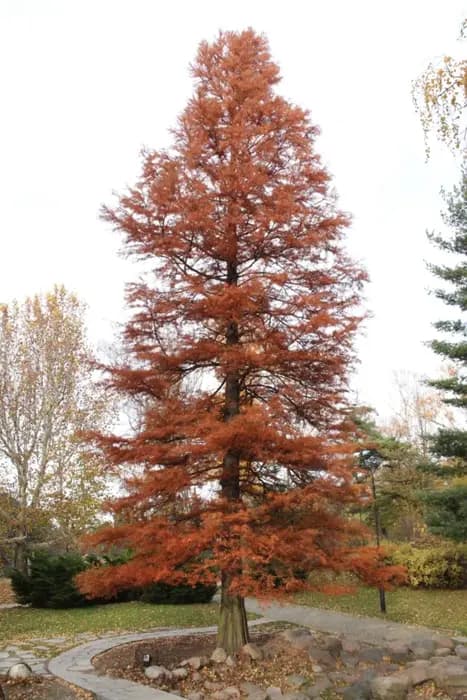
Bald cypress is a deciduous conifer. Its soft, narrow leaves turn russet to orange-brown before falling. Leaves are arranged alternately along the small shoots; dawn redwood has opposite leaves and branchlets.
Bald Cypress · Taxodium distichum
Notice a steady form and a changing detail. Practice returning without holding the scene still.
01 · Meet the tree
A cypress offers several tempos to observe: the apparent stillness of a trunk, the movement of fine foliage, and seasonal changes that unfold over months. Begin with what is visible from a comfortable place.
Bald cypress is a deciduous conifer. Its soft, narrow leaves turn russet to orange-brown before falling. Leaves are arranged alternately along the small shoots; dawn redwood has opposite leaves and branchlets.
Older trees may develop a broad, flared base and fibrous bark. Rounded woody cones offer another identification feature. Root projections called knees can occur, especially in wet sites, but are not present around every tree.
Native to the southeastern United States and parts of the Mississippi Valley, bald cypress grows in swamps and along waterways. It is also planted on suitable upland sites. Remain on established paths or boardwalks when observing wetland trees.
Compare several features, and notice how age and season change their appearance. These photographs are starting points for observation; leave living leaves, needles, cones, and bark attached.
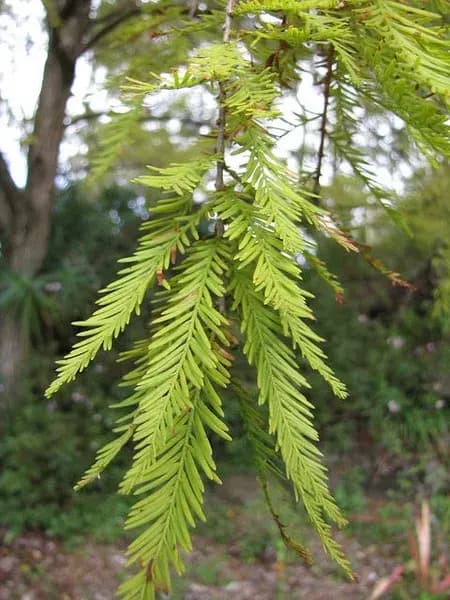
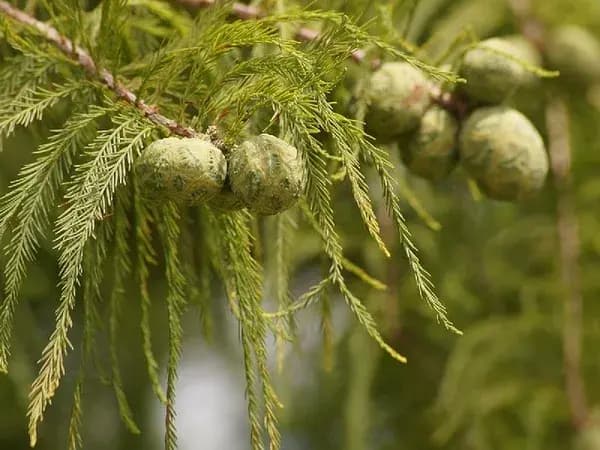
Fresh green foliage emerges in spring and forms fine-textured sprays through summer. Autumn brings russet tones and leaf fall. Winter exposes the branches and trunk. A bare crown in its normal dormant season is part of this conifer’s annual cycle.
Botanical reference: NC State Extension’s bald cypress profile. This is a starting point for observation, not a complete identification key.
02 · Energy & character
Three qualities to contemplate beside the tree. Begin with what you can observe, then see what meaning emerges for you.
These tree-specific associations are new contemplative interpretations for the digital school. “Energy” here describes felt experience and symbolism; it is not a measured healing field or a promise of a particular effect.
The trunk may appear still while foliage, reflections, or nearby plants move.
Use a visible form as a place to return your attention. Returning can be gentle and repeated.
What helps you return when attention scatters?
The same tree changes its appearance across seasons.
Consider an adjustment that fits your present circumstances. Your way of continuing can change as conditions change.
What adjustment would fit the season you are in?
Movement and apparent stillness share the same scene.
Practice including both without needing to control either. You can choose an anchor while remaining aware of your surroundings.
What can you notice without trying to hold it still?
03 · Practice with this tree · About 5 minutes
An original five-minute observation practice. Read once, then take the practice at your own pace beside a tree or with its photograph.
Open outdoor practice →Choose a permitted path, boardwalk, or firm upland viewpoint away from the water’s edge. Sit or stand comfortably with your usual supports. There is no need to approach knees or roots.
Rest your gaze on a section of trunk or a branch at a comfortable height. Notice its outline and the support beneath your own body.
Notice moving foliage, water, a passing sound, or shifting light. In a still scene, notice the ordinary arrival and departure of your own thoughts. Return to the tree’s outline when you wish.
Ask what could help you stay engaged with your day while allowing change. Choose one practical adjustment. Widen your attention and finish at your own pace.
Spend about five minutes, or less if that suits you. Keep your device available when needed. No touching, collecting, controlled breathing, or tree-supported movement is required; leave the tree and its surroundings undisturbed.
04 · Roots in the book
The book teaches attention and learning from trees. This page adds a species-specific encounter; it does not claim that the original book assigned these three energies to bald cypress.
Chapter 3 introduces three pathways and choosing an appropriate setting.
Read the chapter companionOriginal: printed pp. 13–17Chapter 4 encourages a sustainable beginning with five or ten minutes.
Read the chapter companionOriginal: printed p. 28Presence, adaptability, and balance connect this new practice with Chapter 6’s invitations to learn from trees.
Explore Wisdom and WonderOriginal: Chapter 6, printed pp. 96–12405 · Notice for yourself
Reflect quietly or write a sentence in your own notebook. On another visit, look at the same detail again. Your experience may fit these themes, suggest something different, or simply be a few minutes of looking.