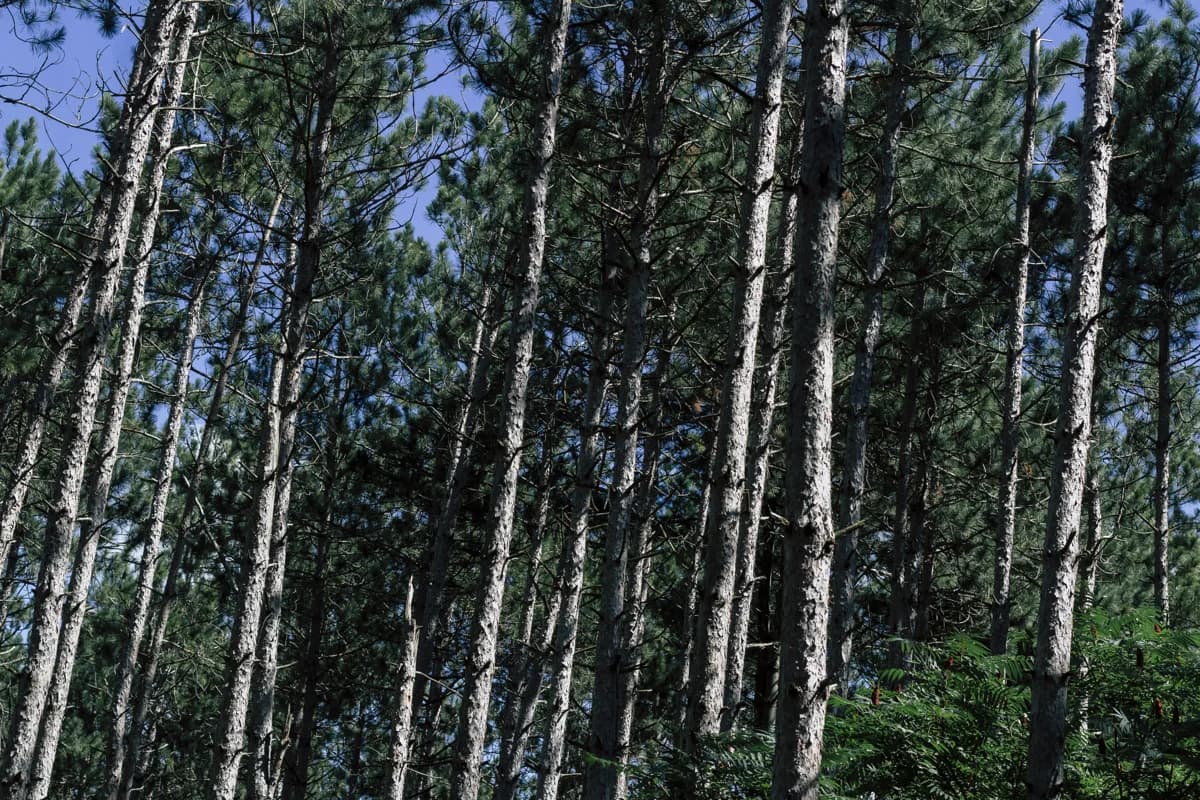
Red pine woodland · Photo: Jason Zhang · CC BY-SA 3.0 · Source · Converted to WebP
01 · Meet the tree
Meet eastern red pine.
Eastern red pine brings long paired needles and warm-toned bark to northern woods. A tall trunk offers one line to follow, while the crown invites attention to the space around it. Look closely before deciding which pine you have met.
Needles
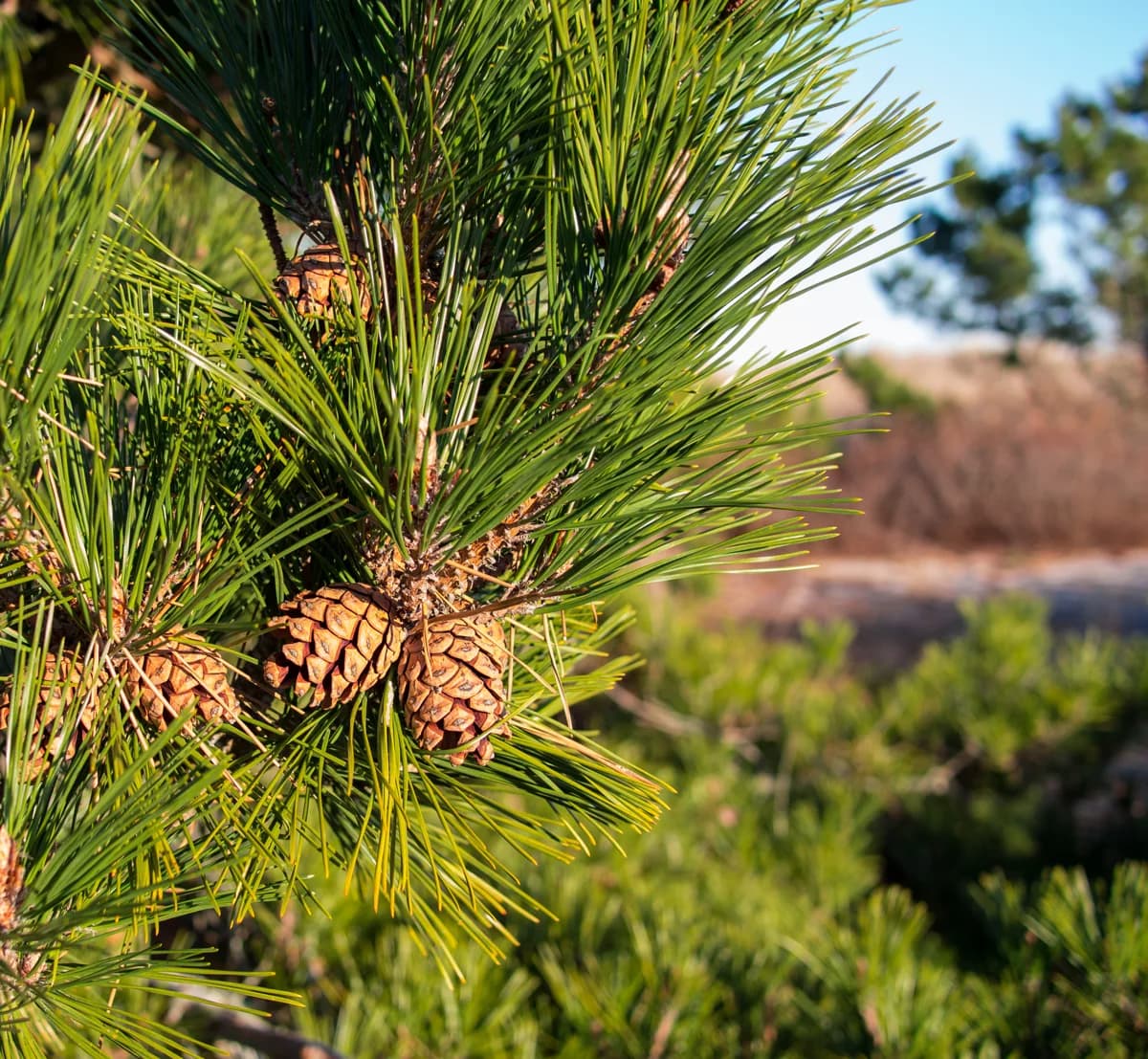
Dark green needles grow in bundles of two and are commonly about four to six inches long. Eastern white pine usually has five needles per bundle, while jack pine has much shorter paired needles. Needle count alone is not a complete identification.
Bark and cones
Mature bark forms reddish-brown scaly plates. Small, egg-shaped seed cones have scales without sharp prickles. Compare bark, needles, and cones without breaking twigs or stripping bark.
Place
Native to the Great Lakes region, southeastern Canada, and New England, red pine grows in sandy, well-drained settings and is also planted in stands. Norway pine is another common name; it does not mean this species is native to Norway.
Look closer.
Compare several features, and notice how age and season change their appearance. These photographs are starting points for observation; leave living leaves, needles, cones, and bark attached.
Cones and needles · Rhododendrites · CC BY-SA 4.0 · Source · Converted to WebP
Watch for fresh spring growth at branch tips and the changing light among evergreen needles. Older needles are eventually shed even while the tree remains green. In winter, reddish bark and the branching outline can offer useful details when cones are out of reach.
Three qualities to contemplate beside the tree. Begin with what you can observe, then see what meaning emerges for you.
These tree-specific associations are new contemplative interpretations for the digital school. “Energy” here describes felt experience and symbolism; it is not a measured healing field or a promise of a particular effect.
Steadiness
A trunk gives the eye a continuous line through the scene.
Choose an anchor for attention without requiring yourself to be rigid.
What helps me settle today?
Attention
Two needles share each bundle.
A small distinction can change how you understand a familiar tree.
What deserves a closer look?
Continuity
Green foliage remains while older needles are replaced.
Continuity can include letting some things go.
What could I keep while allowing change?
03 · Practice with this tree · About 5 minutes
One trunk. A wider view.
A new observation practice exploring steadiness and continuity beside eastern red pine. Sit, stand, or observe from an accessible path.
Keep your usual supports on stable ground in a permitted place. Choose a comfortable viewing angle; you do not need to look up into the tallest branches.
Follow one line
Trace a visible section of trunk or branch with your eyes. Notice changes in bark color and texture without touching or peeling it.
Include the spaces
Let your attention widen to gaps between branches, nearby trees, and the ground. Keep breathing naturally while moving between one detail and the wider scene.
Carry a simple anchor
Choose one small, dependable action you can return to today. Let it be an invitation rather than a demand.
Let the visit be enough.
Spend about five minutes, or less if that suits you. Keep your device available when needed. No touching, collecting, controlled breathing, or tree-supported movement is required; leave the tree and its surroundings undisturbed.
The book teaches attention and learning from trees. This page adds a species-specific encounter; it does not claim that the original book assigned these three energies to eastern red pine.
Choose a tree with care.
Chapter 3 introduces three pathways and choosing an appropriate setting.
What can remain steady while your attention becomes more spacious?
Reflect quietly or write a sentence in your own notebook. On another visit, look at the same detail again. Your experience may fit these themes, suggest something different, or simply be a few minutes of looking.