Leaves
Thick, leathery, alternate leaves are generally oblong to elliptical, glossy above and paler and hairy beneath. Margins are often smooth and rolled under; juvenile growth can be toothed. An oak leaf does not have to be deeply lobed.
 Tree Yoga SchoolPractice with the living world
Southern live oak · Quercus virginiana
Make room beneath a wide view. Notice what shelter can mean today.
01 · Meet the tree
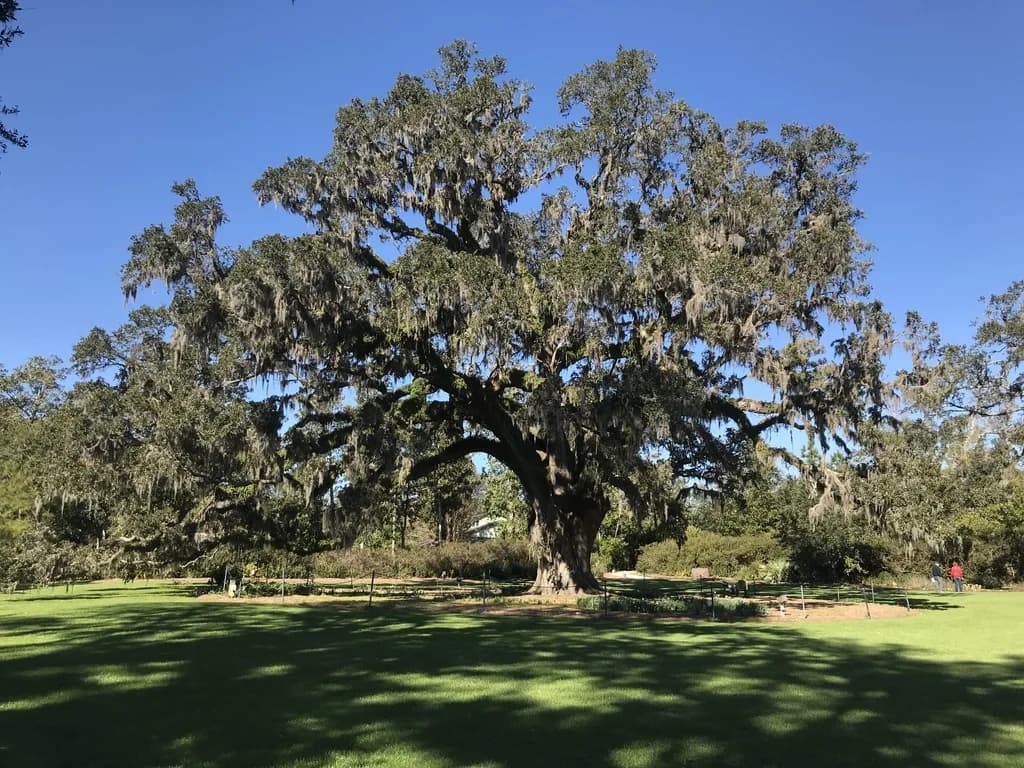
Southern live oak can spread a broad crown across a coastal landscape, with low-reaching limbs and leaves that remain through winter. Let its particular outline lead the encounter, from one branch curve to the wider space around it.
Thick, leathery, alternate leaves are generally oblong to elliptical, glossy above and paler and hairy beneath. Margins are often smooth and rolled under; juvenile growth can be toothed. An oak leaf does not have to be deeply lobed.
Older bark can become dark and blocky with furrows. Acorns mature within one growing season; a scaly cup covers roughly a third of the nut. Combine several features rather than identifying from crown shape alone.
Native to the southeastern United States, especially the Atlantic and Gulf coastal plain, Southern live oak is also planted as a shade tree. A broad crown needs space. Spanish moss may occur on it but is a separate plant, not an identifying feature of the oak.
Compare several features, and notice how age and season change their appearance. These photographs are starting points for observation; leave living leaves, needles, cones, and bark attached.
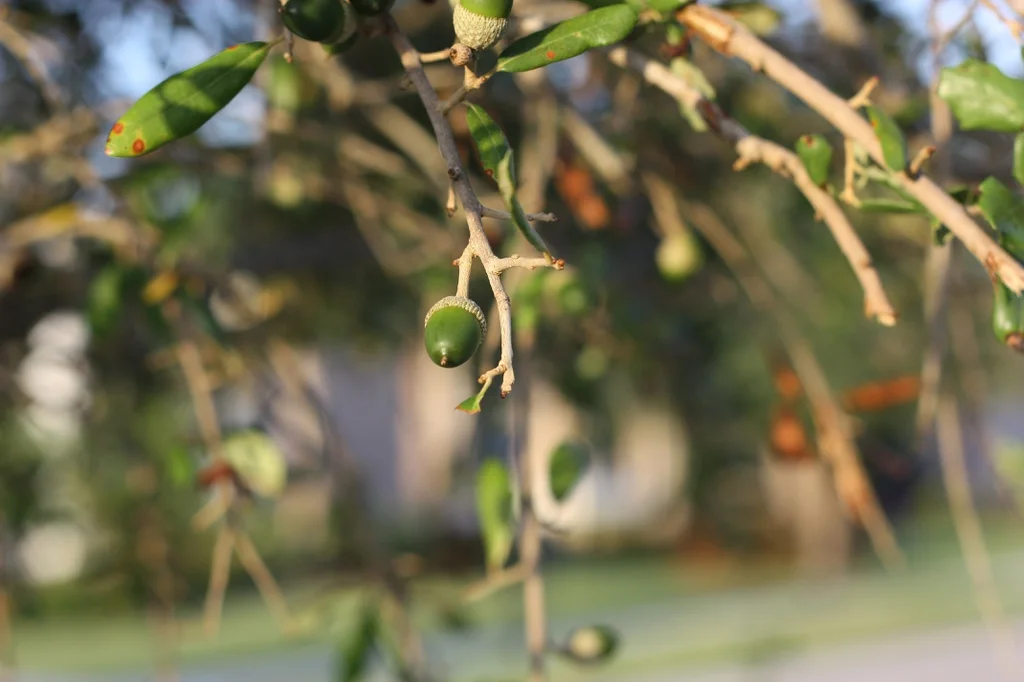
Leaves usually remain through winter and are replaced around the arrival of new spring growth. Watch spring catkins, new leaves, and later acorns when visible. Evergreen presence includes renewal; compare the same branch across visits rather than expecting an unchanging canopy.
Chapter 4 invites a practice of returning across seasons. Read When and Where Try the seasonal observation practice
Botanical reference: NC State Extension’s southern live oak profile. This is a starting point for observation, not a complete identification key.
Out in the world
Choose a place to encounter southern live oak. Each guide brings together arrival, walking, access information, and a practice. Check its dated visitor sources before travelling.
Public park visit
Angel Oak Park · Johns Island, South Carolina
Visitor sources checked .
Plan this visit02 · Energy & character
Three qualities to contemplate beside the tree. Begin with what you can observe, then see what meaning emerges for you.
These tree-specific associations are new contemplative interpretations for the digital school. “Energy” here describes felt experience and symbolism; it is not a measured healing field or a promise of a particular effect.
A spreading crown makes a large area of shade.
Reflect on the support that lets a person rest or grow.
What kind of support would help today?
Long branches extend away from the trunk.
Let a wide view suggest room for more than one concern.
Where could I make a little room?
Old leaves give way as new foliage arrives.
A continuing commitment can include replacement and change.
What can continue in a new form?
03 · Practice with this tree · About 5 minutes
A new five-minute observation practice exploring shelter and spaciousness beside Southern live oak. A permitted distant viewpoint is enough, including at protected trees such as Angel Oak.
Open outdoor practiceUse a stable path-side viewpoint or bench with your usual supports. Follow barriers and site rules; do not stand on roots, climb limbs, or place belongings against a protected tree.
Choose a visible branch curve and follow it with your eyes. Let the shape unfold at a comfortable viewing angle, without needing to reach or touch it.
Widen your attention to the openings between limbs, changing light, and surrounding life. Let your breathing remain natural.
Ask what would make room for rest or growth in your day. Choose one small act of care, then finish by returning your attention to the tree.
Spend about five minutes, or less if that suits you. Keep your device available when needed. No touching, collecting, controlled breathing, or tree-supported movement is required; leave the tree and its surroundings undisturbed.
04 · Roots in the book
The book teaches attention and learning from trees. This page adds a species-specific encounter; it does not claim that the original book assigned these three energies to southern live oak.
Chapter 3 introduces three pathways and choosing an appropriate setting.
Read the chapter companionOriginal: printed pp. 13–17Chapter 4 encourages a sustainable beginning with five or ten minutes.
Read the chapter companionOriginal: printed p. 28Presence, balance and optimization, and unconditional love connect this new practice with Chapter 6’s invitations to learn from trees.
Explore Wisdom and WonderOriginal: Chapter 6, printed pp. 96–12405 · Notice for yourself
Reflect quietly or write a sentence in your own notebook. On another visit, look at the same detail again. Your experience may fit these themes, suggest something different, or simply be a few minutes of looking.