Bark
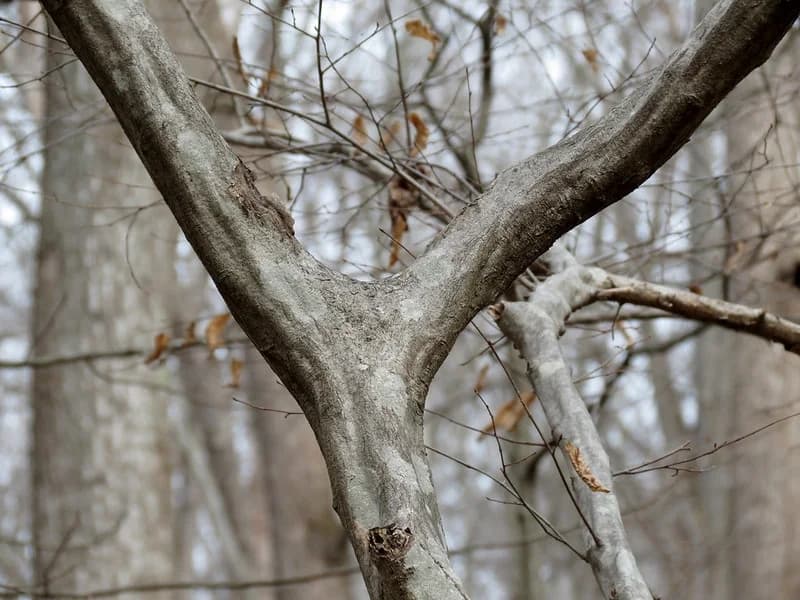
Smooth gray bark follows a fluted trunk and branches, creating the muscular appearance behind the name musclewood. American hophornbeam is a different species with rougher bark.
American hornbeam · Carpinus caroliniana
Follow one curve. Notice the support that lets you soften your effort.
01 · Meet the tree
A small tree can hold your attention as fully as a giant. Begin with the lines of its trunk, then notice the space around it. Let your encounter take its own scale.
Smooth gray bark follows a fluted trunk and branches, creating the muscular appearance behind the name musclewood. American hophornbeam is a different species with rougher bark.
Simple, alternate leaves have toothed edges and prominent side veins. Small nutlets accompany leafy, three-lobed bracts. Compare bark, leaves, and fruit when available.
A member of the birch family native to eastern North America, American hornbeam often grows beneath taller trees in moist woods and beside streams.
Compare several features, and notice how age and season change their appearance. These photographs are starting points for observation; leave living leaves, needles, cones, and bark attached.
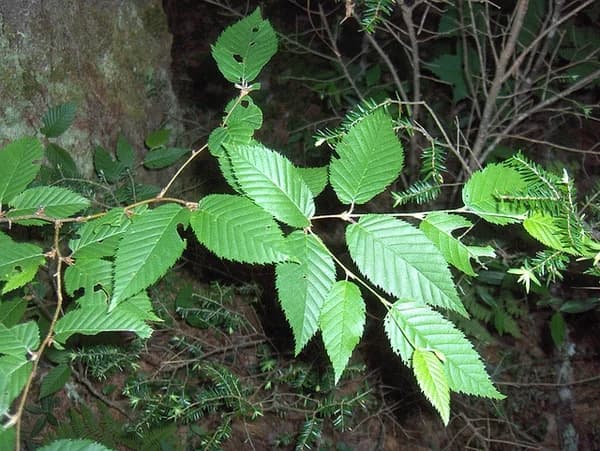
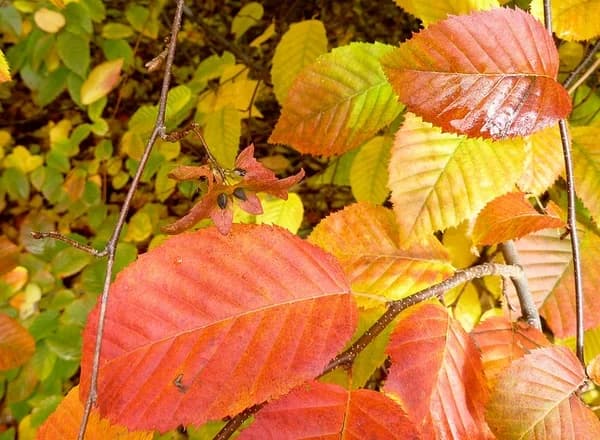
Look for catkins and unfolding leaves in spring. Summer reveals leaf veins and bracts; autumn may bring yellow, orange, or red. The trunk's fluted lines remain visible in winter.
Botanical reference: NC State Extension’s american hornbeam profile. This is a starting point for observation, not a complete identification key.
02 · Energy & character
Three qualities to contemplate beside the tree. Begin with what you can observe, then see what meaning emerges for you.
These tree-specific associations are new contemplative interpretations for the digital school. “Energy” here describes felt experience and symbolism; it is not a measured healing field or a promise of a particular effect.
Light and shade reveal the curves of a modest-sized trunk.
Let the form prompt a question about strength in your own life. Consider the steady effort that can be easy to overlook.
What quiet effort is already supporting you?
One curve becomes clearer as your eyes follow its changing edge.
Give a small part of your experience enough time to become specific. You can attend closely without tightening your whole body.
Where could a little less effort make room for clearer attention?
The tree stands among soil, neighboring plants, and changing light.
Use the surrounding scene as a reminder to recognize your own sources of support. Receiving help can be part of continuing.
Which support could you acknowledge today?
03 · Practice with this tree · About 5 minutes
An original five-minute observation practice exploring quiet strength and the support available to you.
Open outdoor practice →Sit or stand comfortably on permitted, stable ground, using your usual supports. Remain on the path near streams. Let the seat or ground carry your weight.
Choose a line in the bark at an easy height. Trace it slowly with your eyes. A branch outline works too; you can stay at a distance.
Notice your jaw, shoulders, or hands. If comfortable, ease one small area of tension. Keep breathing naturally and return your eyes to the curve.
Name something that helps you continue: a person, a place, a routine, or a practical tool. Choose one way to appreciate or use that support today.
Spend about five minutes, or less if that suits you. Keep your device available when needed. No touching, collecting, controlled breathing, or tree-supported movement is required; leave the tree and its surroundings undisturbed.
04 · Roots in the book
The book teaches attention and learning from trees. This page adds a species-specific encounter; it does not claim that the original book assigned these three energies to american hornbeam.
Chapter 3 introduces three pathways and choosing an appropriate setting.
Read the chapter companionOriginal: printed pp. 13–17Chapter 4 encourages a sustainable beginning with five or ten minutes.
Read the chapter companionOriginal: printed p. 28Presence, balance and optimization, and acceptance connect this new practice with Chapter 6’s invitations to learn from trees.
Explore Wisdom and WonderOriginal: Chapter 6, printed pp. 96–12405 · Notice for yourself
Reflect quietly or write a sentence in your own notebook. On another visit, look at the same detail again. Your experience may fit these themes, suggest something different, or simply be a few minutes of looking.