Leaves
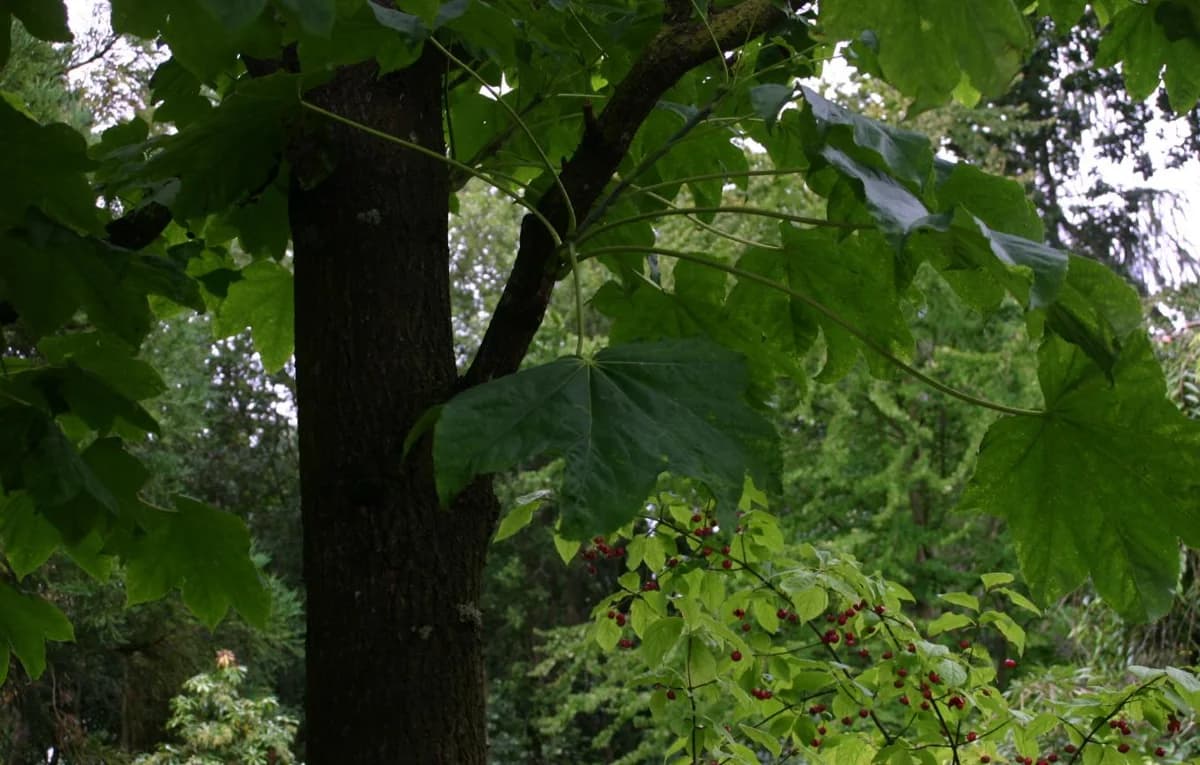
Large, simple leaves are alternate, palmately lobed, and toothed, often with five to seven lobes. The leaf may resemble castor bean foliage, but castor aralia is a different plant. Leaf shape alone is not a complete identification.
 Tree Yoga SchoolPractice with the living world
Castor aralia · Kalopanax septemlobus
Look closely from a comfortable distance. Curiosity and care can grow together.
01 · Meet the tree
Castor aralia combines large, lobed leaves with a trunk and branches that can bear spines. This East Asian tree is an invitation to recognize an unfamiliar form while respecting the distance that makes observation comfortable.
Large, simple leaves are alternate, palmately lobed, and toothed, often with five to seven lobes. The leaf may resemble castor bean foliage, but castor aralia is a different plant. Leaf shape alone is not a complete identification.
Young trunks and branches may carry substantial spines. These tend to become less prominent on older trunks and large branches, while mature bark becomes dark gray, ridged, and furrowed. Do not assume a mature tree is free of spines.
Clusters of small creamy white flowers appear in summer, followed by dark fruits in autumn. Native to eastern Asia, castor aralia is cultivated in arboreta, including Smith College. Kalopanax pictus is an older botanical name.
Compare several features, and notice how age and season change their appearance. These photographs are starting points for observation; leave living leaves, needles, cones, and bark attached.

Watch large leaves expand in spring, look for summer flower clusters, and notice dark fruits and changing foliage later in the year. In winter, observe branching and bark from a comfortable distance. Spines are a reason to choose an observation practice rather than a trunk embrace.
Chapter 4 invites a practice of returning across seasons. Read When and Where Try the seasonal observation practice
Botanical reference: NC State Extension’s castor aralia profile. This is a starting point for observation, not a complete identification key.
Out in the world
Choose a place to encounter castor aralia. Each guide brings together arrival, walking, access information, and a practice. Check its dated visitor sources before travelling.
Campus arboretum
Smith College Campus Arboretum · Northampton, Massachusetts
Visitor sources checked .
Plan this visit02 · Energy & character
Three qualities to contemplate beside the tree. Begin with what you can observe, then see what meaning emerges for you.
These tree-specific associations are new contemplative interpretations for the digital school. “Energy” here describes felt experience and symbolism; it is not a measured healing field or a promise of a particular effect.
A broad leaf holds several deep lobes.
Let an unfamiliar outline become a question rather than an instant answer.
What might I learn by looking again?
A leaf can resemble that of an unrelated plant.
Resemblance is an invitation to check, not proof of identity.
What would help me understand more carefully?
Spines can be present on the trunk or branches.
A comfortable distance can support appreciation.
What boundary would help me pay attention with ease?
03 · Practice with this tree · About 5 minutes
A new no-touch observation practice exploring curiosity and boundaries beside castor aralia. This practice does not involve hugging, leaning against, or using the tree for support.
Open outdoor practiceStay on a stable, permitted route, with your usual supports. Keep clear of trunks and branches that may bear spines; there is no need to approach the bark.
Choose a visible leaf edge, crown silhouette, or branch angle. Follow the shape with your eyes without reaching into foliage.
Name one thing you can see, then one question you cannot yet answer. Let that uncertainty remain while breathing naturally.
Consider a boundary that would make your day more comfortable or attentive. Finish by including the whole tree and leaving it undisturbed.
Spend about five minutes, or less if that suits you. Keep your device available when needed. No touching, collecting, controlled breathing, or tree-supported movement is required; leave the tree and its surroundings undisturbed.
04 · Roots in the book
The book teaches attention and learning from trees. This page adds a species-specific encounter; it does not claim that the original book assigned these three energies to castor aralia.
Chapter 3 introduces three pathways and choosing an appropriate setting.
Read the chapter companionOriginal: printed pp. 13–17Chapter 4 encourages a sustainable beginning with five or ten minutes.
Read the chapter companionOriginal: printed p. 28Presence, acceptance, and balance and optimization connect this new practice with Chapter 6’s invitations to learn from trees.
Explore Wisdom and WonderOriginal: Chapter 6, printed pp. 96–12405 · Notice for yourself
Reflect quietly or write a sentence in your own notebook. On another visit, look at the same detail again. Your experience may fit these themes, suggest something different, or simply be a few minutes of looking.