Needles and buds
Flat needles attach singly and spiral around the twig, though they may appear two-ranked. Pointed, oval-conical buds provide another clue. Douglas-fir belongs to Pseudotsuga rather than the true-fir genus Abies.
 Tree Yoga SchoolPractice with the living world
Douglas-fir · Pseudotsuga menziesii
Begin with one clear clue. Let a careful look strengthen your next step.
Optional · saved in this browser on this device.
01 · Meet the tree
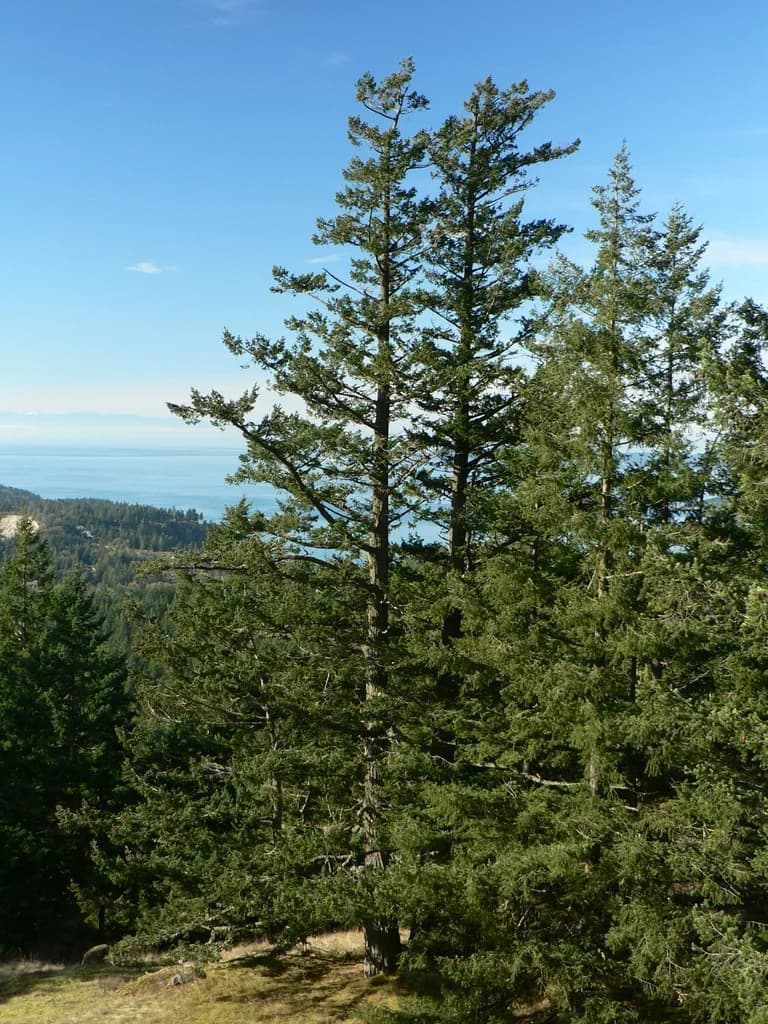
Douglas-fir offers a memorable identification clue in the three-pointed bracts projecting from its hanging cones. Beyond the name is a particular tree shaped by its growing conditions, inviting both careful looking and a grounded sense of direction.
Flat needles attach singly and spiral around the twig, though they may appear two-ranked. Pointed, oval-conical buds provide another clue. Douglas-fir belongs to Pseudotsuga rather than the true-fir genus Abies.
Hanging woody cones have distinctive three-pronged bracts between the scales. Mature bark can become thick, reddish-brown, and deeply furrowed. Look at naturally fallen cones or attached cones already in view without collecting living material.
Native to western North America, Douglas-fir has coastal and interior forms across a broad range. Oregon State distinguishes Pacific Coast and Rocky Mountain types. Foliage color and crown shape vary; do not expect every tree to match one garden photograph.
Compare several features, and notice how age and season change their appearance. These photographs are starting points for observation; leave living leaves, needles, cones, and bark attached.
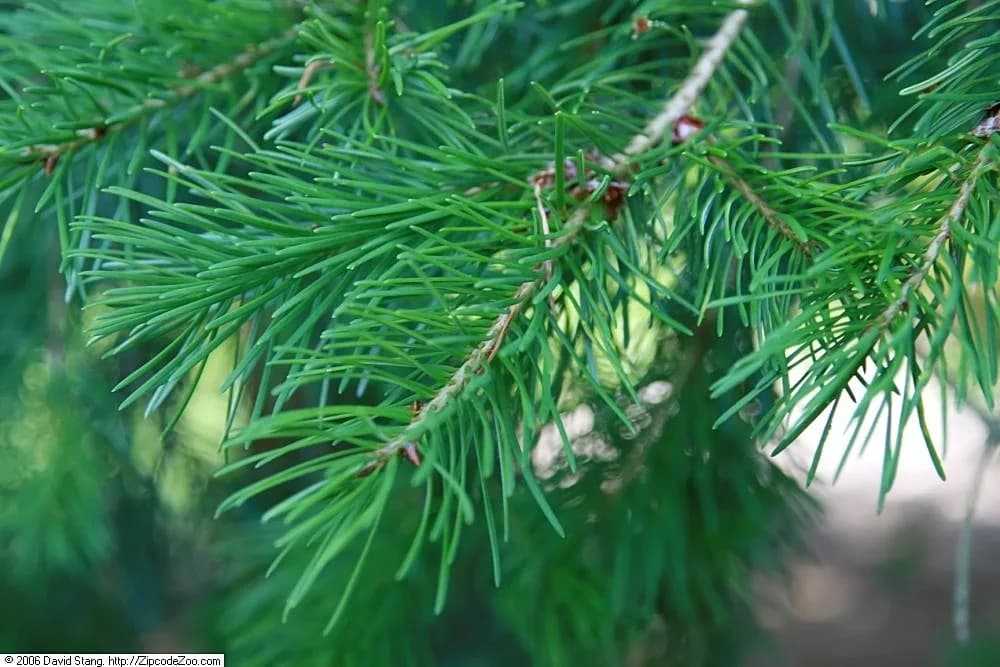
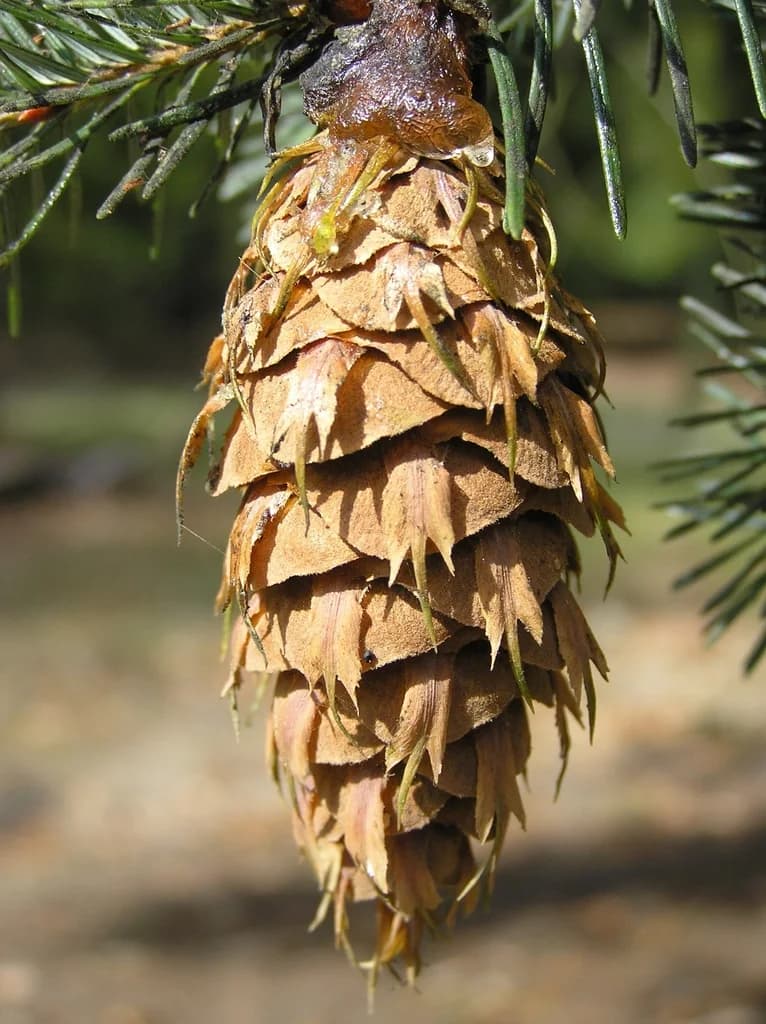
Notice new shoot growth, developing cones when present, and the contrast between evergreen foliage and changing surroundings. Fallen cones can offer a useful seasonal clue. Return to an accessible branch or trunk detail without using tree height as a proxy for age.
Chapter 4 invites a practice of returning across seasons. Read When and Where Try the seasonal observation practice
Botanical reference: NC State Extension’s douglas-fir profile. This is a starting point for observation, not a complete identification key.
Explore the habitat: Oregon State University: Douglas-fir identification and coastal/interior forms.
02 · Energy & character
Three qualities to contemplate beside the tree. Begin with what you can observe, then see what meaning emerges for you.
These tree-specific associations are new contemplative interpretations for the digital school. “Energy” here describes felt experience and symbolism; it is not a measured healing field or a promise of a particular effect.
Three-pointed cone bracts offer a specific visible clue.
Use a concrete observation to refine an initial impression.
What evidence would help me decide?
Branches and trunk form a continuing direction of growth.
Consider an intention you can carry with flexibility rather than force.
What is one clear next step?
Coastal and interior forms share a species name.
Leave room for variation within a familiar category.
What difference might I be overlooking?
03 · Practice with this tree · About 5 minutes
A new five-minute practice connecting careful observation with resolve beside Douglas-fir. Identification is a question to explore, not a test to finish.
Open outdoor practiceUse a permitted path-side viewpoint and your usual supports. Choose a branch, trunk section, or fallen cone you can see comfortably.
Look for a cone bract, an individual needle, or a bark ridge. Describe only what is visible, leaving the name uncertain when the clues are incomplete.
Include nearby branches and surrounding trees. Notice variation without needing to compare which tree is better or more impressive.
Name one action supported by what you actually know today. Finish by returning your attention to the place.
Spend about five minutes, or less if that suits you. Keep your device available when needed. No touching, collecting, controlled breathing, or tree-supported movement is required; leave the tree and its surroundings undisturbed.
04 · Roots in the book
The book teaches attention and learning from trees. This page adds a species-specific encounter; it does not claim that the original book assigned these three energies to douglas-fir.
Chapter 3 introduces three pathways and choosing an appropriate setting.
Read the chapter companionOriginal: printed pp. 13–17Chapter 4 encourages a sustainable beginning with five or ten minutes.
Read the chapter companionOriginal: printed p. 28One-pointed focus, presence, and adaptability connect this new practice with Chapter 6’s invitations to learn from trees.
Explore Wisdom and WonderOriginal: Chapter 6, printed pp. 96–12405 · Notice for yourself
Reflect quietly or write a sentence in your own notebook. On another visit, look at the same detail again. Your experience may fit these themes, suggest something different, or simply be a few minutes of looking.