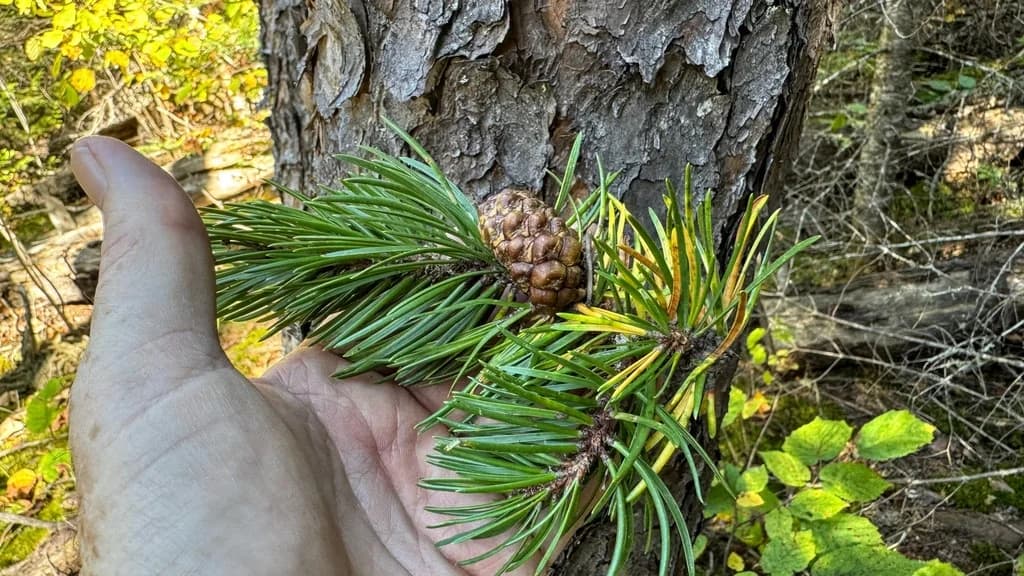
Needles
Short, stiff, often twisted needles grow in bundles of two. They are much shorter than the long needles of eastern red pine. Compare more than one bundle on an accessible twig or naturally fallen branch.
 Tree Yoga SchoolPractice with the living world
Jack pine · Pinus banksiana
Let an irregular branch remind you that growth has more than one shape.
01 · Meet the tree
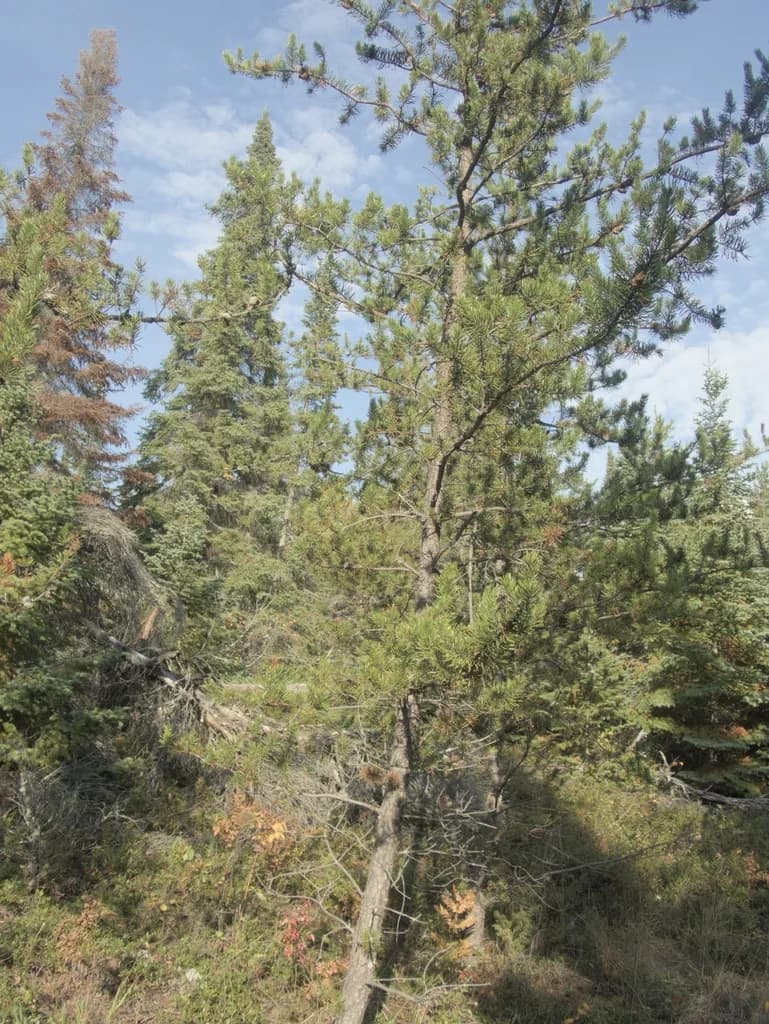
Jack pine can grow into a wonderfully uneven crown: short needles, persistent cones, and branches shaped by light and place. Meet its particular outline before imagining what a tree ought to look like.
Short, stiff, often twisted needles grow in bundles of two. They are much shorter than the long needles of eastern red pine. Compare more than one bundle on an accessible twig or naturally fallen branch.
Cones often curve along the branch and can remain attached, some still closed. Bark develops irregular fissures with age. Cone behavior varies; a closed cone alone does not prove identity.
Native to northern North America, including parts of northeastern North America, jack pine grows in sunny, often sandy or nutrient-poor settings. Its young pyramidal crown may become open, spreading, or irregular as it ages.
Compare several features, and notice how age and season change their appearance. These photographs are starting points for observation; leave living leaves, needles, cones, and bark attached.
Notice new needle growth in spring and persistent cones across later visits. Winter foliage can look more yellow-green. Compare the same crown through changing light rather than expecting an evergreen to look identical all year. Leave cones attached and never heat or burn them to test identification.
Chapter 4 invites a practice of returning across seasons. Read When and Where Try the seasonal observation practice
Botanical reference: NC State Extension’s jack pine profile. This is a starting point for observation, not a complete identification key.
02 · Energy & character
Three qualities to contemplate beside the tree. Begin with what you can observe, then see what meaning emerges for you.
These tree-specific associations are new contemplative interpretations for the digital school. “Energy” here describes felt experience and symbolism; it is not a measured healing field or a promise of a particular effect.
Crowns can become open and irregular with age.
Consider how your own plans might respond to actual conditions.
Where would a small adjustment help?
One branch may take an unexpected direction.
An unfamiliar shape need not be a mistake.
What is useful about my own way of growing?
Some cones remain closed on the tree.
Let an unfinished thing remain unfinished for a moment.
What can I allow more time?
03 · Practice with this tree · About 5 minutes
A new five-minute practice exploring adaptability through the outline of jack pine. No handling of needles or cones is needed.
Open outdoor practiceSettle on a permitted path or stable viewpoint. Keep a comfortable distance from branches and use your usual seat or supports.
Choose a branch angle or gap in the crown. Follow it with your eyes, noticing where the outline differs from a simple triangle.
Notice whether you are judging the shape. Let the thought pass and return to a visible detail. Your breath can stay ordinary.
Think of a plan that could benefit from a small change. Name one adjustment that fits your real circumstances, then return your attention to the place.
Spend about five minutes, or less if that suits you. Keep your device available when needed. No touching, collecting, controlled breathing, or tree-supported movement is required; leave the tree and its surroundings undisturbed.
04 · Roots in the book
The book teaches attention and learning from trees. This page adds a species-specific encounter; it does not claim that the original book assigned these three energies to jack pine.
Chapter 3 introduces three pathways and choosing an appropriate setting.
Read the chapter companionOriginal: printed pp. 13–17Chapter 4 encourages a sustainable beginning with five or ten minutes.
Read the chapter companionOriginal: printed p. 28Adaptability, acceptance, and perseverance connect this new practice with Chapter 6’s invitations to learn from trees.
Explore Wisdom and WonderOriginal: Chapter 6, printed pp. 96–12405 · Notice for yourself
Reflect quietly or write a sentence in your own notebook. On another visit, look at the same detail again. Your experience may fit these themes, suggest something different, or simply be a few minutes of looking.