Needles
Stiff needles usually occur in bundles of three. Short needle-bearing shoots can appear on trunks or older branches. Compare cones, bark, and place with other pines; three-needle bundles alone are not enough.
Pitch Pine · Pinus rigida
Begin again from the place where you stand.
01 · Meet the tree
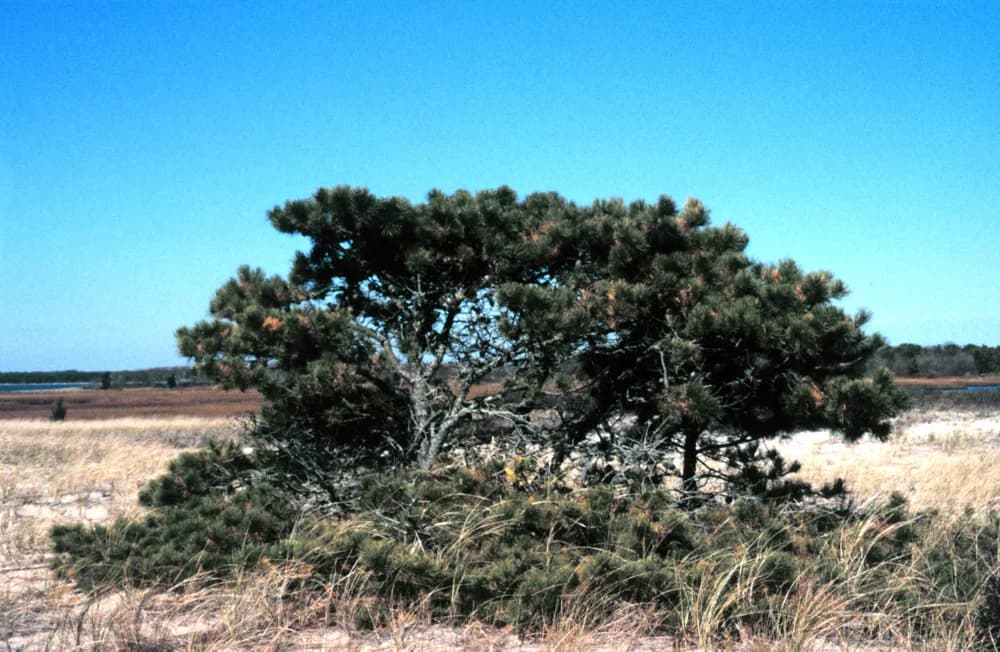
A pitch pine’s irregular crown and textured trunk invite a close, unhurried encounter. In Massachusetts pine barrens, this species belongs to a community shaped by sandy ground, light, and disturbance. Let resilience mean finding support for a new beginning, with no demand to turn difficulty into a lesson.
Stiff needles usually occur in bundles of three. Short needle-bearing shoots can appear on trunks or older branches. Compare cones, bark, and place with other pines; three-needle bundles alone are not enough.
Mature bark becomes thick, rough, and dark; seed cones have prickly scales and can remain on branches. Observe without scraping bark or collecting cones.
Native to eastern North America, pitch pine grows in sandy barrens and on rocky sites. It can resprout after some damage, including fire, but individual trees can still be harmed or killed. Fire management belongs to trained land stewards.
Compare several features, and notice how age and season change their appearance. These photographs are starting points for observation; leave living leaves, needles, cones, and bark attached.
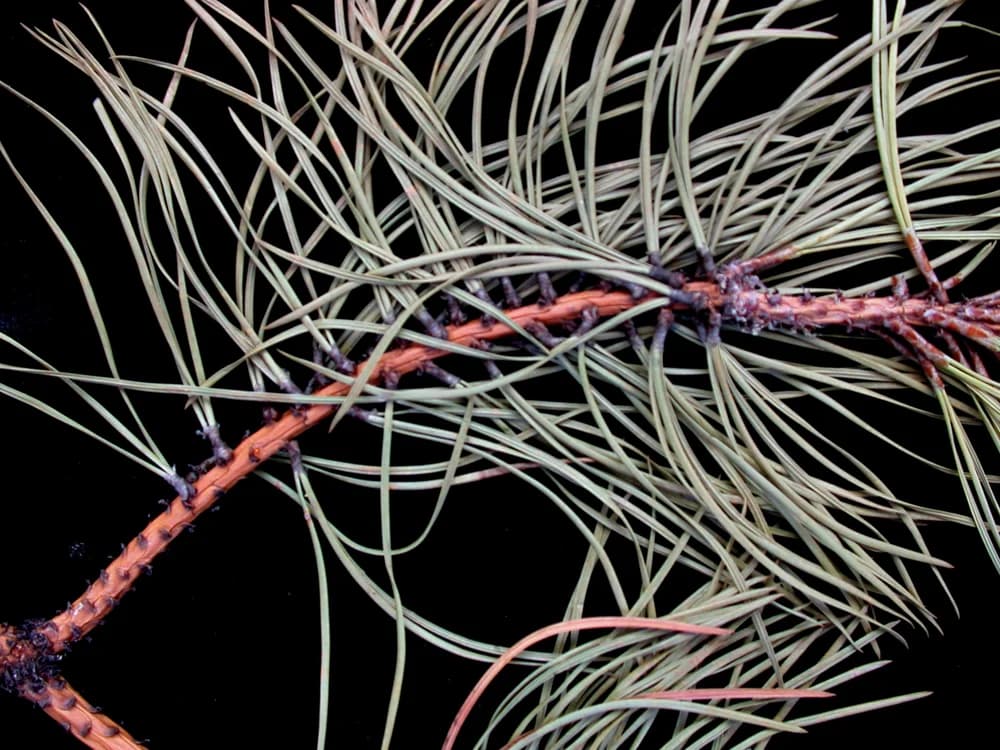
Green needles remain through winter while older bundles eventually fall. Spring brings new shoots and pollen cones; developing seed cones and fresh growth can be noticed on later visits. Return to the same visible detail across seasons. An irregular crown does not, by itself, reveal a tree’s history.
Botanical reference: NC State Extension’s pitch pine profile. This is a starting point for observation, not a complete identification key.
Explore the habitat: MassWildlife: Dry woodlands and barrens.
02 · Energy & character
Three qualities to contemplate beside the tree. Begin with what you can observe, then see what meaning emerges for you.
These tree-specific associations are new contemplative interpretations for the digital school. “Energy” here describes felt experience and symbolism; it is not a measured healing field or a promise of a particular effect.
An individual tree grows within the conditions of its place.
Ask what support would help you continue, rather than requiring yourself to withstand everything.
What helps you keep going with care?
New shoots may grow from an older trunk or branch.
Let a new beginning coexist with what has already shaped your life.
What small beginning is available now?
The pine stands among ground plants, other trees, and wildlife.
Consider your relationship with a place through returning and caring for it.
How could you care for a place you return to?
03 · Practice with this tree · About 5 minutes
An original five-minute observation practice. Read once, then give your attention to the tree; sitting, standing, or observing from a distance are equally welcome.
Open outdoor practice →Choose stable, permitted ground in suitable weather, clear of damaged limbs. Sit or stand with your usual supports and leave fragile barrens vegetation undisturbed.
Notice a needle cluster, a small shoot, or a patch of bark without touching it. Let your breathing remain natural.
Bring to mind something you would like to resume or start. Name a support you need; there is no need to feel strong or interpret the tree’s scars.
Choose one small beginning and one act of care for the place, such as taking your litter home. Widen your attention before returning along the path.
Spend about five minutes, or less if that suits you. Keep your device available when needed. No touching, collecting, controlled breathing, or tree-supported movement is required; leave the tree and its surroundings undisturbed.
04 · Roots in the book
The book teaches attention and learning from trees. This page adds a species-specific encounter; it does not claim that the original book assigned these three energies to pitch pine.
Chapter 3 introduces three pathways and choosing an appropriate setting.
Read the chapter companionOriginal: printed pp. 13–17Chapter 4 encourages a sustainable beginning with five or ten minutes.
Read the chapter companionOriginal: printed p. 28Resilience, Renewal, Belonging connect this new practice with Chapter 6’s invitations to learn from trees.
Explore Wisdom and WonderOriginal: Chapter 6, printed pp. 96–12405 · Notice for yourself
Reflect quietly or write a sentence in your own notebook. On another visit, look at the same detail again. Your experience may fit these themes, suggest something different, or simply be a few minutes of looking.