Bark
Younger trunks often show shiny yellow-bronze or silvery bark with thin horizontal curls. Older bark becomes darker and scaly. This differs from paper birch's familiar white bark; age changes both species' appearance.
Yellow birch · Betula alleghaniensis
Let a closer look deepen what you know. Follow a small detail without needing to uncover everything.
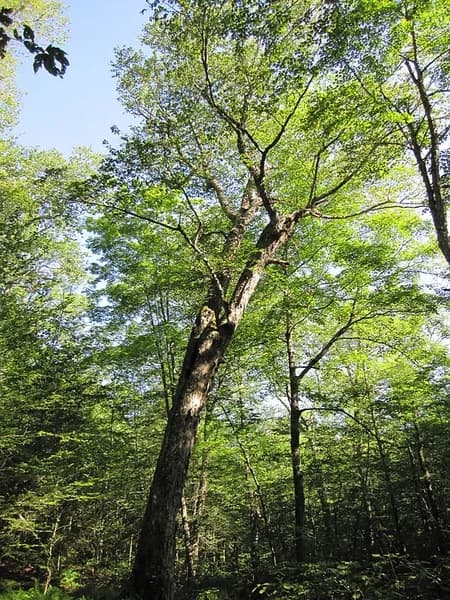
01 · Meet the tree
Yellow birch invites attention to texture and time. Its bark can show fine curls on younger surfaces and rougher plates on older trunks. Meet those differences as they appear, leaving every layer attached.
Younger trunks often show shiny yellow-bronze or silvery bark with thin horizontal curls. Older bark becomes darker and scaly. This differs from paper birch's familiar white bark; age changes both species' appearance.
Alternate leaves have pointed tips and doubly toothed edges. Catkins appear in spring; upright, compact seed-bearing structures develop later. Compare bark, leaves, and twigs together.
Yellow birch is native to eastern North America and is associated with cool, moist forests. Observe from a stable path; a moist forest floor is not automatically a suitable place to stand.
Compare several features, and notice how age and season change their appearance. These photographs are starting points for observation; leave living leaves, needles, cones, and bark attached.
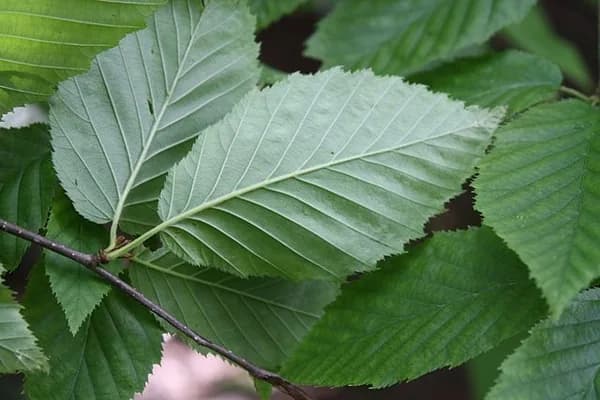
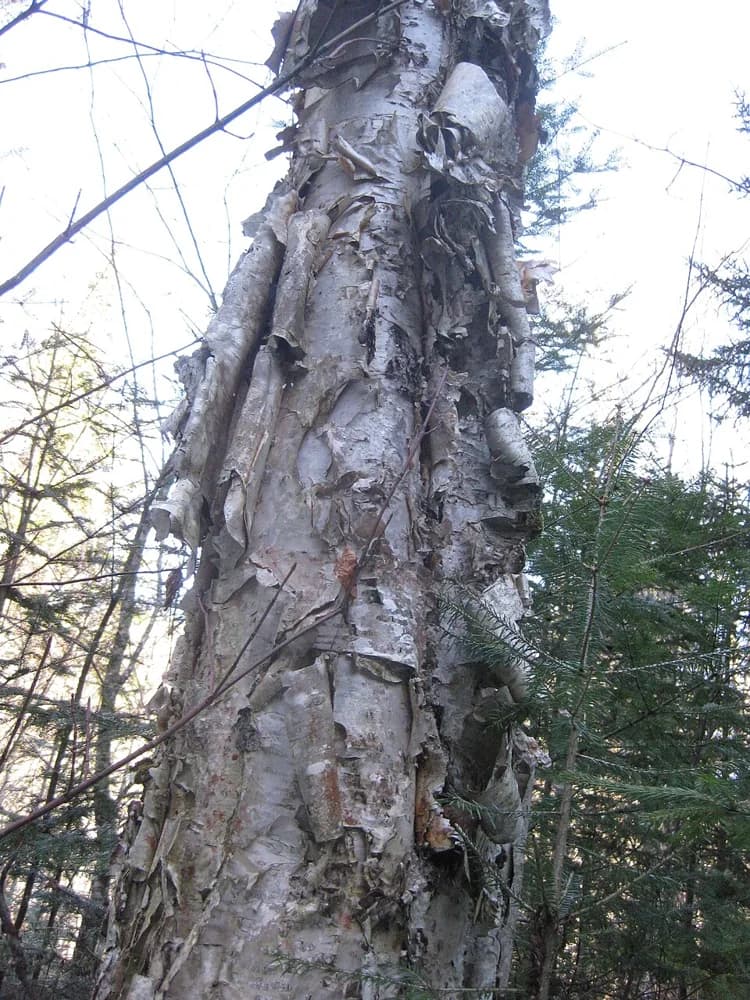
Look for unfolding leaves and catkins in spring, green foliage in summer, and yellow leaves in autumn. Winter reveals more bark and twig structure. A curl you notice today may look different in another light; leave the bark intact and return to observe it again.
Botanical reference: NC State Extension’s yellow birch profile. This is a starting point for observation, not a complete identification key.
02 · Energy & character
Three qualities to contemplate beside the tree. Begin with what you can observe, then see what meaning emerges for you.
These tree-specific associations are new contemplative interpretations for the digital school. “Energy” here describes felt experience and symbolism; it is not a measured healing field or a promise of a particular effect.
Several bark textures can be visible on the same tree.
Let earlier and newer parts of your experience belong to one life. You can keep what is useful while learning something new.
What would you like to carry forward?
Fine curls and exposed surfaces create a changing pattern on younger bark.
Treat renewal as something to notice, not something to force. A new beginning can coexist with an established commitment.
What is quietly taking a new form?
A close view of bark reveals details that are difficult to see from a distance.
Ask a more precise question before reaching a conclusion. Familiarity can be the beginning of inquiry.
What have you not yet noticed?
03 · Practice with this tree · About 5 minutes
A new five-minute practice of observation and reflection beside yellow birch, connecting curiosity with presence and care.
Open outdoor practice →Find a permitted place on firm ground where you can see the trunk comfortably. Use your usual seat or standing supports. A distant view is enough.
Notice a color, a line, and a texture. Keep bark attached; do not peel or scratch it to discover what lies underneath.
Return to your first detail and notice whether the light changes your description. Let your breathing remain natural and your interpretation stay open.
Consider something familiar in your day. Choose a question that could help you see it more clearly, then finish the visit without needing an answer.
Spend about five minutes, or less if that suits you. Keep your device available when needed. No touching, collecting, controlled breathing, or tree-supported movement is required; leave the tree and its surroundings undisturbed.
04 · Roots in the book
The book teaches attention and learning from trees. This page adds a species-specific encounter; it does not claim that the original book assigned these three energies to yellow birch.
Chapter 3 introduces three pathways and choosing an appropriate setting.
Read the chapter companionOriginal: printed pp. 13–17Chapter 4 encourages a sustainable beginning with five or ten minutes.
Read the chapter companionOriginal: printed p. 28Presence, adaptability, and perseverance connect this new practice with Chapter 6’s invitations to learn from trees.
Explore Wisdom and WonderOriginal: Chapter 6, printed pp. 96–12405 · Notice for yourself
Reflect quietly or write a sentence in your own notebook. On another visit, look at the same detail again. Your experience may fit these themes, suggest something different, or simply be a few minutes of looking.